
Understanding, questioning and correctly interpreting media was the central theme of a recent evening event held at the Bildungszentrum St. Bernhard in Wiener Neustadt. The event was organised by Peter Mazohl and focused on the EU co-funded BonJour! project (Erasmus+ 2023-1-IT02-KA220-ADU-000160320, focusing on media literacy), which aims to strengthen media literacy among adults aged 55 and over.
The BonJour! project offers a web-based learning platform designed to help older adults develop important digital and media skills. Participants can learn how to create digital content and gain a more profound understanding of how images, news, and social media shape our perception. A particular focus is placed on recognising reliable information, identifying fake news, and critically evaluating media content.
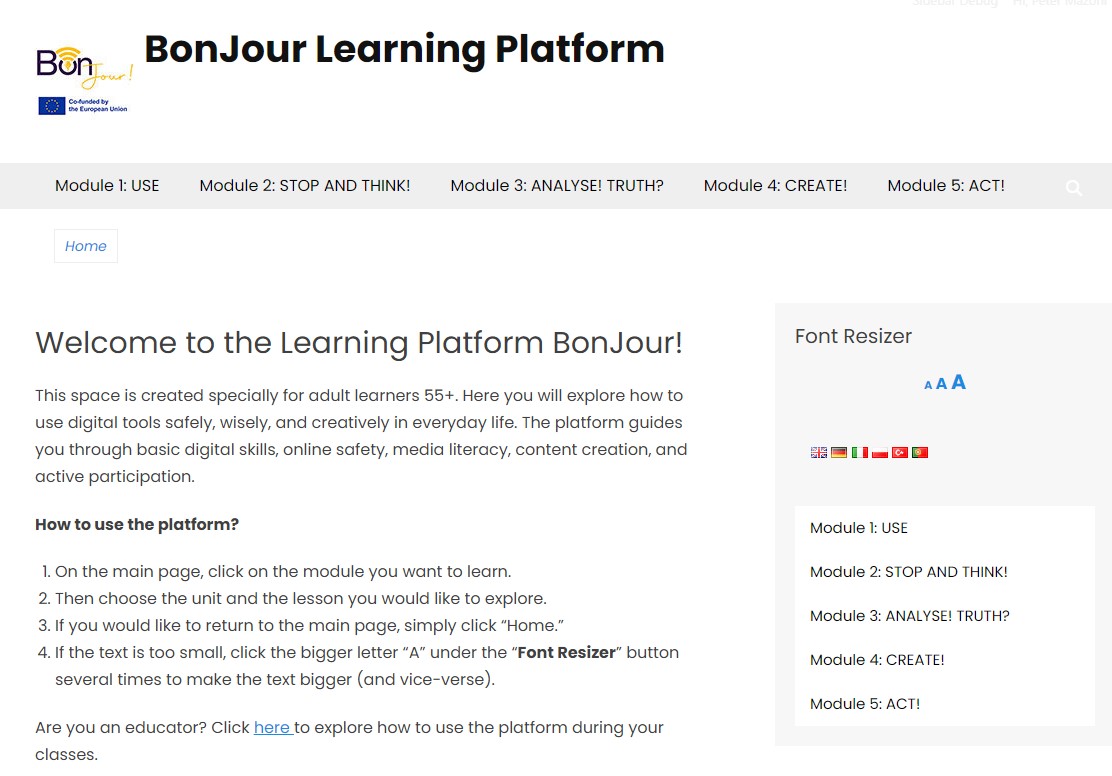
Screenshot of the opening page of the learning platform.
During the event, several speakers provided short impulse presentations from different professional perspectives. Peter Mazohl, the Austrian project coordinator, introduced the BonJour! project and highlighted the importance of media literacy in an increasingly digital society.
Philipp Grabner, formerly a local journalist and now a member of the editorial team of the Niederösterreichische Nachrichten, spoke about the importance of local journalism and the challenges faced by today’s media landscape. His presentation addressed how misinformation and filter bubbles can influence public opinion.
Michael Mazohl, media consultant, podcaster and author, explored the dynamics of social media under the title “Links, Likes and Lies”. His talk focused on how online platforms influence communication, visibility and the spread of information.
Finally, media educator Harald Makl presented the structure of the BonJour! learning platform. The platform consists of five modules and offers personalised learning paths, automated progress analysis and feedback. It is designed to be easy to use and to support learners in developing media competence independently.
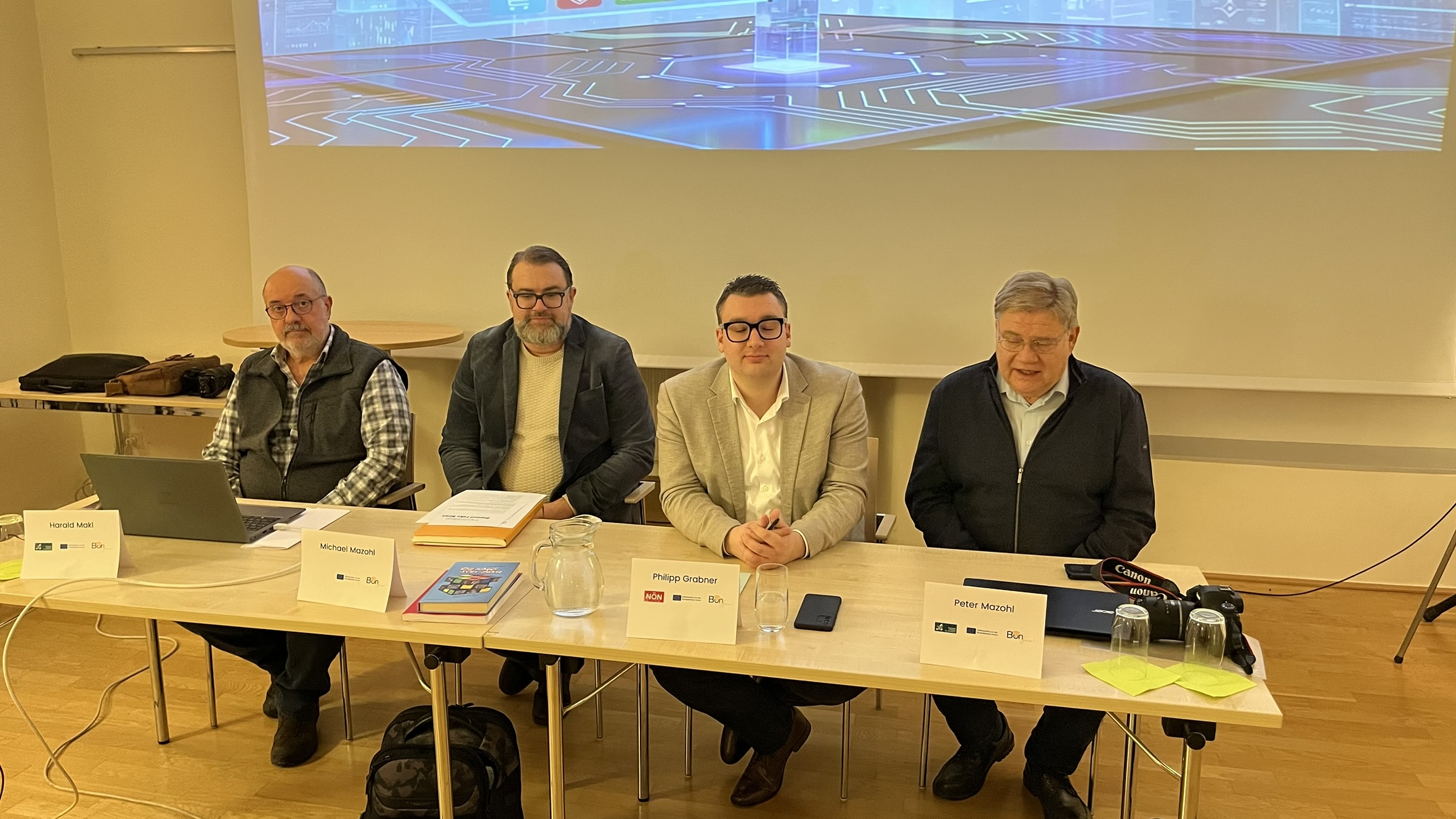
The panellists of the event (from left to right): Harald Makl (Media Educator), Michael Mazohl (Blogger, Author and media consultant), Philipp Grabner (Journalist) and Peter Mazohl (Head of the EBI)
Open for questions
The evening concluded with a panel discussion and open Q&A session, giving participants the opportunity to ask questions and share their perspectives. The event ended in a relaxed atmosphere with a small buffet, allowing for further conversations and exchange of ideas.
The strong interest from participants showed that media literacy is an increasingly important topic—especially for older adults who want to navigate the digital world confidently and responsibly.
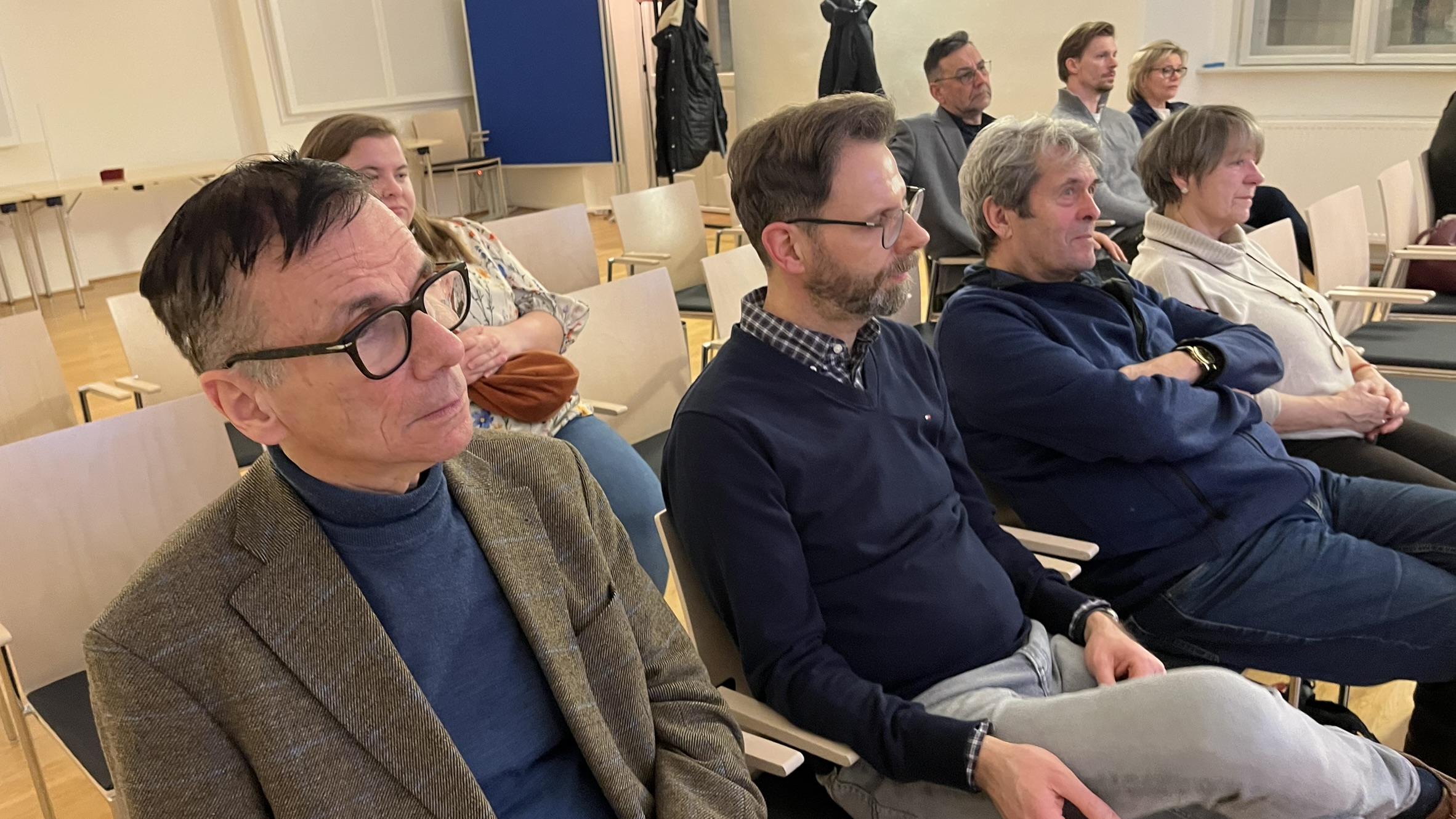
The audience was first listening the introduction, but started timely an interesting discussion with the panellists.
Funded by the European Union. Views and opinions expressed are however those of the author(s) only and do not necessarily reflect those of the European Union or the European Education and Culture Executive Agency (EACEA). Neither the European Union nor EACEA can be held responsible for them.
When a digital learning platform is designed for adults aged 55 and over, usability is not just a technical concern — it is central to whether the platform works at all. If people find a system confusing, frustrating, or difficult to navigate, they are unlikely to engage with it, regardless of how strong the content may be. This is why the BonJour! Project team chose to evaluate the platform using one of the most established methods in the field: the System Usability Scale, or SUS.
What is the System Usability Scale?
The SUS is a standardised questionnaire that has been used in usability research for decades. It consists of ten short statements about a system — covering aspects such as ease of use, consistency, learnability, and user confidence. Participants respond on a five-point scale, ranging from “strongly disagree” to “strongly agree”. The responses are then converted into a single score between 0 and 100.
Scores above 68 are considered above average. Scores above 80 indicate very good usability, and scores approaching or exceeding 90 are regarded as excellent — placing a system in the top tier of comparable digital tools.
How the evaluation was carried out
A total of 30 participants took part in the evaluation across five modules of the BonJour! platform. The questionnaire was administered in German, maintaining the language of the training programme. After completing each module, participants answered the ten SUS questions, allowing the team to assess usability not just for the platform as a whole, but for each module individually.
What the results show
The results are encouraging across the board. The overall mean SUS score for the platform was 84.8 out of 100, placing it firmly in the “very good” range and close to the threshold that benchmarks describe as excellent.
Looking at the individual modules, a clear pattern emerges. Module 1 — the entry point to the course — achieved a score of 76.3. While this is still a good result, it is the lowest of the five modules. This is not surprising: first encounters with a new platform often require more orientation, and users naturally need some time to familiarise themselves with the structure and navigation. The scores then rise consistently, with Module 2 reaching 83.3, Module 5 84.2, and Module 4 an impressive 89.6.
The standout result belongs to Module 3 — Analyse! Truth? — which achieved a mean SUS score of 91.9. This places it in the “excellent” category and suggests that the module’s design, structure, and interaction flow were particularly well received. It represents a best-practice example within the course and offers useful insights for further development of other modules.
The graphic compared the various modules, in context with the mean value over all modules.
What participants said, in numbers
At the level of individual questionnaire items, participants rated the platform particularly highly for ease of use, the quality of integrated functions, and how quickly they were able to learn to use the system. User confidence while navigating the platform was also notably high. Minor variation appeared in responses related to the need for technical support and the perception of consistency — areas that are worth monitoring in future iterations, though they do not indicate any systematic problem.
What this means in practice
A SUS score of 84.8 is a strong result for any digital platform. For a learning tool aimed specifically at adults who may have varying levels of digital experience, it is particularly meaningful. It suggests that the BonJour! platform is accessible, intuitive, and well-structured — and that most users can engage with it without significant barriers.
Usability of this standard supports not only a positive user experience, but also the educational goals of the project. When a platform is easy to use, learners can focus on what matters: the content, the activities, and the skills they are developing. The BonJour! evaluation results suggest the platform is delivering on that promise.
The System Usability Scale (SUS) is a short, standardised questionnaire used to measure how easy a system is to use. It consists of ten statements — five positive and five negative — which users rate on a scale from 1 (strongly disagree) to 5 (strongly agree).
The responses are converted into a single score between 0 and 100. This score reflects the overall usability of a system as perceived by its users. It does not measure technical performance, but captures how confident, comfortable, and in control users feel when interacting with the system.
Scores are interpreted against established benchmarks:
Below 68 — below average; improvements are needed
68–79 — good; the system performs adequately
80–89 — very good; users find the system largely intuitive
90–100 — excellent; the system is considered best-in-class
SUS is widely used in usability research because it is quick to complete, easy to analyse, and produces reliable results even with small groups of participants. It can be applied to any system — digital or physical — and is particularly useful for comparing usability across different versions or modules of a product.
In a time when news no longer lies printed on the breakfast table but appears on our smartphones every second, the nature of information has changed fundamentally. In the past, editorials in well-known newspapers formed the basis of public debate; today they compete with short-lived “likes” and often questionable messages on social networks. This clearly calls for “media literacy for seniors” and for all citizens who want to engage with media in a critical way.
For many citizens, especially for the generation that grew up with the reliability of traditional journalism, an urgent question arises: Who can we still trust in this digital labyrinth?
Digital change offers great opportunities for participation, but it also brings risks for social cohesion. Disinformation and targeted false messages can polarise debates and weaken trust in our democratic institutions. The generation 55+ in particular faces a new challenge here: to combine their many years of life experience with the technical mechanisms of the digital world.
Where does the personal opinion of a user end, and where does a systematic lie begin? To recognise this narrow line, more than technical knowledge is needed – it requires a return to the principles of professional journalism.
This is exactly where our upcoming event begins. We are pleased to welcome two experts who will help bring clarity to the dense flow of information:
A leading journalist will speak about the struggle for objectivity in the digital age and explain why well-researched editorials are still an essential compass today.
An experienced media consultant, author and blogger will provide insights into the careful practice of research. Using his current book, which is based on more than 200 verified sources, he will show that truth is not a coincidence, but the result of hard and systematic work.
The BonJour! Project: building bridges and strengthening skills
Behind these activities stands the BonJour Project. Our goal is to strengthen the media literacy of older adults in a sustainable way. We believe that media education is not a privilege of the young, but a necessary condition for active citizenship at every age.
We developed the new professional role of the “Media Educator for the Elderly” – specialists who support seniors in becoming not only consumers, but confident and critical actors in the digital world. The aim is to strengthen critical thinking, increase self-confidence, and build bridges between generations.
These efforts are supported by an online course that offers an overview in five modules. It introduces basic knowledge about working on the internet, understanding the difference between facts and opinions, and creating reliable journalistic publications. The self-learning course is available on an easy-to-access platform: BonJour! Training Kurs and is offered in German, English, Italian, Portuguese, Polish, and Turkish.
Invitation to dialogue
We warmly invite you to become part of this important debate. Let us learn together how to recognise the mechanisms of manipulation and bring the quality of information back to the centre of public discussion.
Stay informed, stay critical – together let us preserve the culture of well-founded words.
“In the end, media literacy for seniors is the central heart of our work in the Erasmus+ BonJour! project, because it acts as a digital shield against disinformation and gives the generation 55+ the confidence they need to take part in social dialogue safely, critically, and independently in the digital age.”Peter Mazohl
Funded by the European Union. Views and opinions expressed are however those of the author(s) only and do not necessarily reflect those of the European Union or the European Education and Culture Executive Agency (EACEA). Neither the European Union nor EACEA can be held responsible for them.
In einer Zeit, in der Nachrichten nicht mehr nur gedruckt auf dem Frühstückstisch liegen, sondern im Sekundentakt auf unseren Smartphones aufpoppen, hat sich das Wesen der Information grundlegend verändert. Früher bildeten Leitartikel namhafter Zeitungen das Fundament der öffentlichen Debatte; heute konkurrieren sie mit flüchtigen „Likes“ und oft zweifelhaften Meldungen in den sozialen Netzwerken. Das schreit nach “Medienkompetenz für Senioren” und alle Bürger, die sich kritisch mit Medien auseinandersetzen wollen.
Für viele Bürger, insbesondere für die Generation, die mit der Verlässlichkeit des klassischen Journalismus aufgewachsen ist, stellt sich eine drängende Frage: Wem können wir in diesem digitalen Labyrinth noch glauben?
Der schmale Grat zwischen Meinung und Manipulation
Der digitale Wandel bietet enorme Chancen für die Teilhabe, doch er birgt auch Risiken für den gesellschaftlichen Zusammenhalt. Desinformation und gezielte Falschmeldungen polarisieren Debatten und gefährden das Vertrauen in unsere demokratischen Institutionen. Besonders die Generation 55+ steht hier vor einer neuen Herausforderung: Es gilt, die jahrzehntelange Lebenserfahrung mit den technischen Mechanismen der digitalen Welt zu verknüpfen.
Wo endet die persönliche Meinung eines Nutzers, und wo beginnt die systematische Lüge? Um diesen schmalen Grat zu erkennen, bedarf es mehr als nur technisches Verständnis – es bedarf einer Rückbesinnung auf das journalistische Handwerk.
Genau hier setzt unsere kommende Veranstaltung an. Wir freuen uns, zwei Experten begrüßen zu dürfen, die Licht in das Dickicht der Informationsflut bringen:
Ein führender Journalist wird über das Ringen um Objektivität im digitalen Zeitalter berichten und aufzeigen, warum fundierte Leitartikel gerade heute als Kompass unverzichtbar sind.
Ein erfahrener Medienberater, Autor und Blogger gewährt Einblicke in die akribische Praxis der Recherche. Am Beispiel seines aktuellen Buches, das auf über 200 verifizierten Quellen basiert, demonstriert er, dass Wahrheit kein Zufallsprodukt ist, sondern das Ergebnis harter, methodischer Arbeit.
Das BonJour!-Projekt: Brücken bauen, Kompetenz stärken
Hinter diesen Bemühungen steht das BonJour-Projekt. Unser Ziel ist es, die Medienkompetenz älterer Erwachsener nachhaltig zu stärken. Wir sind überzeugt: Medienbildung ist kein Privileg der Jugend, sondern eine notwendige Voraussetzung für aktive Bürgerschaft in jedem Alter.
Wir entwickelten das neue Berufsbild des „Media Educator for the Elderly“ – Spezialisten, die Senioren dabei unterstützen, nicht nur Konsumenten, sondern souveräne und kritische Akteure in der digitalen Welt zu sein. Es geht darum, das kritische Denken zu schärfen, die Selbstwirksamkeit zu fördern und die Kluft zwischen den Generationen zu überbrücken.
Unterstützt werden diese Bemühungen durch einen Onlinekurs, der in fünf Modulen einen Überblick über Basiswissen zum Arbeiten im Internet, dem Problem der Unterscheidung von Fakten und Meinungen und eigenen journalistisch seriösen Veröffentlichungen anbietet. Der Selbstlernkurs ist auf einer niedrigschwelligen Plattform zu erreichen: BonJour! Training Kurs und steht in den Sprachen Deutsch, Englisch, Italienisch, Portugiesisch, Polnisch und Türkisch zur Verfügung.
Einladung zum Dialog
Wir laden Sie herzlich ein, Teil dieser wichtigen Debatte zu werden. Lassen Sie uns gemeinsam lernen, wie wir die Mechanismen der Manipulation durchschauen und die Qualität der Information wieder in den Mittelpunkt rücken.
Bleiben Sie informiert, bleiben Sie kritisch – bewahren wir gemeinsam die Kultur des fundierten Wortes.
„Letztlich ist Medienkompetenz für Senioren das entscheidende Herzstück unserer Arbeit im Erasmus+ BonJour! Projekt, da sie als digitaler Schutzschild gegen Desinformation fungiert und der Generation 55+ die nötige Souveränität verleiht, um auch im digitalen Zeitalter sicher, kritisch und selbstbestimmt am gesellschaftlichen Dialog teilzunehmen.“Peter Mazohl
Funded by the European Union. Views and opinions expressed are however those of the author(s) only and do not necessarily reflect those of the European Union or the European Education and Culture Executive Agency (EACEA). Neither the European Union nor EACEA can be held responsible for them.