
Blended Learning = Simple Delivery of Learning?

Preamble “Blend the Learning”
In 2013, I started wit a project on Quality in Blended Learning. I felt it necessary to examine the concept of Blended Learning – which is interesting in principle – from the perspective of quality: teaching must meet certain quality standards.
This led to a two-year project in which a European project group (Grundtvig Adult Education Project 539717-LLP-1-2013-1-IT-GRUNDTVIG-GMP) addressed the issue and developed solutions. One of the outcomes was a book on quality in Blended Learning. Nevertheless, a certain dissatisfaction remained, as there were no concepts in Blended Learning that were, in principle, effective.
In autumn 2018, I met Jon Bergmann, and he had the solution: the Flipped Learning 3.0 Framework, which uses Blended Learning as a concept but satisfies all outstanding requirements within the complete framework.
Ten years after the end of the ‘Quality in Blended Learning Project’ (this is the archive of the project’s web page), I venture a critical assessment of the current situation.
1 Introduction
Blended Learning has become one of the most widely used concepts in educational discourse over the past two decades. It appears in policy documents, institutional strategies, funding programmes, and conference presentations across the world. Everybody seems to be doing it. And yet, if you ask ten educators what Blended Learning actually means, you will likely get ten different answers. That is not a sign of a rich and nuanced concept. It is a warning signal.
This paper argues that Blended Learning, despite its popularity, is conceptually too vague to serve as a meaningful guide for educational design. It lacks a shared definition, a clear pedagogical foundation, and consistent design principles. As a result, it risks becoming — or perhaps already is — little more than a convenient buzzword.
2 Conceptual Ambiguity of Blended Learning
A review of the literature reveals that blended learning is defined in multiple and sometimes contradictory ways. Some authors describe it as a straightforward combination of online and face-to-face instruction. Others insist on the need for deliberate pedagogical integration. The gap between these positions is significant.
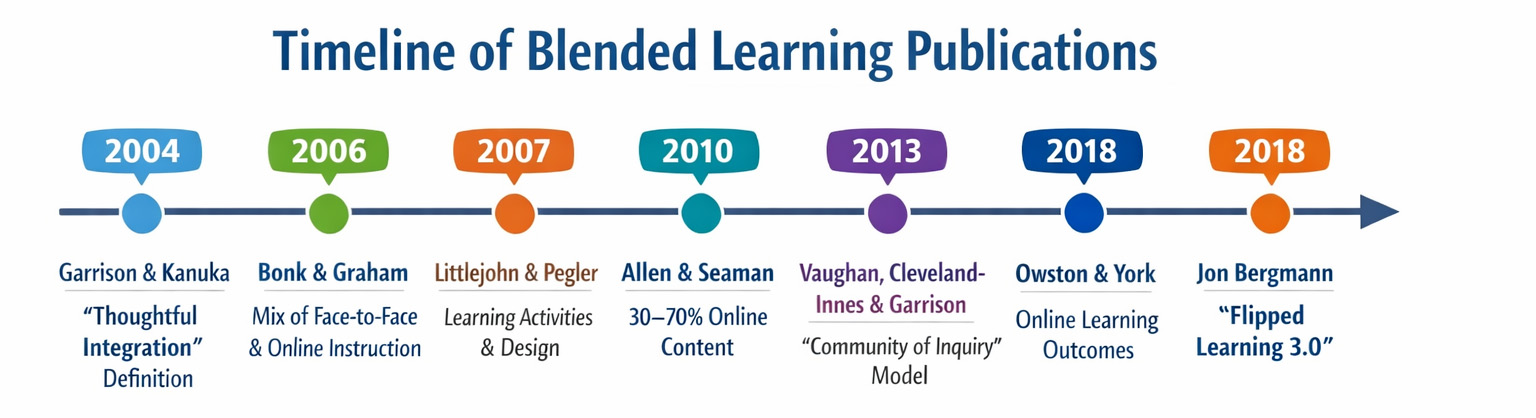
Garrison and Kanuka (2004) offered what became one of the most cited definitions: Blended Learning as “the thoughtful integration of classroom face-to-face learning experiences with online learning experiences.” The key word here is “thoughtful” — suggesting that simply putting some content online does not qualify. Bonk and Graham (2006), on the other hand, described it more structurally as the combination of face-to-face instruction with computer-mediated instruction, leaving the door open for far simpler interpretations.
Allen and Seaman (2010) approached the concept from a purely quantitative angle, defining Blended Learning as any course where between 30 and 70 per cent of instruction takes place online. This percentage-based view reduces a complex educational question to a simple ratio. It tells us nothing about what happens during those online or face-to-face hours, or whether they connect meaningfully at all.
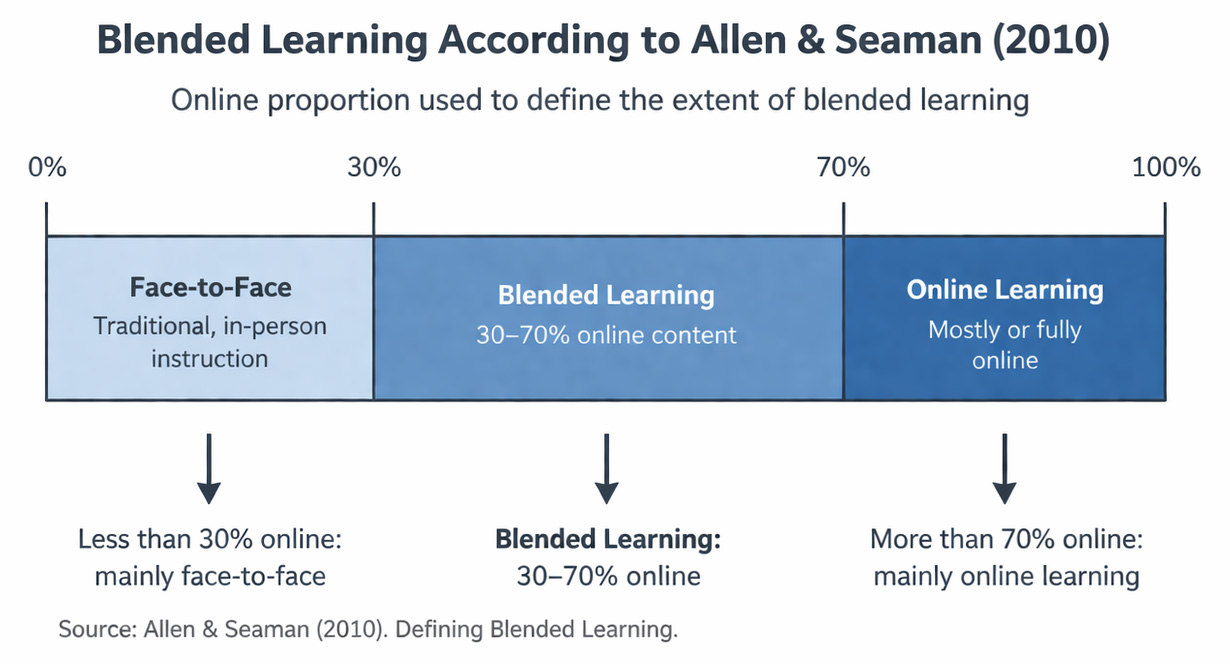
This conceptual ambiguity is not a minor academic debate. It directly limits the analytical and practical value of Blended Learning as a concept. If the same label can describe a carefully designed course built around collaborative inquiry and a course that simply uploads lecture slides to a learning management system, then the label is doing very little work.
3 Lack of Pedagogical Specificity
To be fair, some authors acknowledge this openly. Bonk and Graham (2006) note that Blended Learning can accommodate a wide range of pedagogical approaches. But acknowledging openness is not the same as providing guidance. A teacher or course designer looking for clear principles will not find them in the Blended Learning literature. What they will find is flexibility — which, on its own, is not enough.
Garrison and Kanuka (2004) rightly emphasise that Blended Learning requires the alignment of learning objectives, activities, and interaction formats. But this is simply good instructional design — not a feature unique to Blended Learning. Any well-designed course, regardless of its format, should do the same.
4 The “Anything Goes” Problem
Due to its broad and flexible definition, Blended Learning risks becoming an umbrella term under which almost any instructional design can be categorised. A short video clip added to a traditional lecture. A weekly online quiz alongside face-to-face seminars. A fully online course with one in-person workshop per semester. All of these can be — and have been — labelled as Blended Learning.
This “anything goes” characteristic is not just intellectually unsatisfying. It has real consequences. When everything qualifies as Blended Learning, the concept loses its capacity to distinguish between good and poor design. It becomes impossible to evaluate whether a blended approach is actually better than a purely face-to-face or purely online alternative — because “blended” no longer means anything specific enough to test.
Owston and York (2018) found that the proportion of online content mattered less than expected for learning outcomes, with the best results appearing at 33 to 50 per cent online. This is useful data. But it still does not tell us what kind of online content, in what sequence, for what purpose, and with what pedagogical rationale — the questions that actually matter for course design.
5 Blended Learning as a Buzzword
This matters. When institutions invest in Blended Learning without a clear definition of what that means in practice, the result is often inconsistent implementation. Some departments may interpret it as flipped classroom design; others as simply adding a Moodle page to an existing course. Both counts. Neither is necessarily wrong. But neither is the same thing.
There is also a risk that positive connotations obscure the absence of pedagogical substance. A course labelled as Blended Learning may receive institutional approval and funding precisely because of the label, rather than because of any clearly defined learning rationale. The term has become, in some contexts, a quality signal without quality criteria.
6 Consequences for Practice and Research
The conceptual vagueness of Blended Learning has practical consequences. In course design, it can lead to inconsistent decisions, unclear learning outcomes, and difficulty in evaluating whether a particular design is effective. If a course does not work well, is it because of the blend, the pedagogy, the content, or the context? Without a clearer framework, it is hard to know — and hard to improve.
For research, the problem is equally significant. Studies on Blended Learning are notoriously difficult to compare because they use different definitions, different measures, and different contexts. A meta-analysis of Blended Learning research is, in many ways, a meta-analysis of several quite different things. This limits the cumulative value of the evidence base.
For projects requiring clear and comparable design criteria — such as Erasmus+ partnerships working across institutions and national contexts — this vagueness is particularly problematic. Shared implementation becomes difficult when the core concept means different things to different partners.
7 Towards a More Precise Alternative
To move beyond the limitations of Blended Learning as a broad and ambiguous concept, more precise design frameworks are needed. These frameworks should explicitly define the pedagogical principles that guide course design, the types of learning activities included, the role of face-to-face and online components, and the methods used to assess learning.
Littlejohn and Pegler (2007) point in a useful direction, emphasising the importance of learning activities and didactic design rather than the format itself. Vaughan, Cleveland-Innes, and Garrison (2013) offer the Community of Inquiry model as one possible framework, grounding blended design in principles of cognitive, social, and teaching presence.
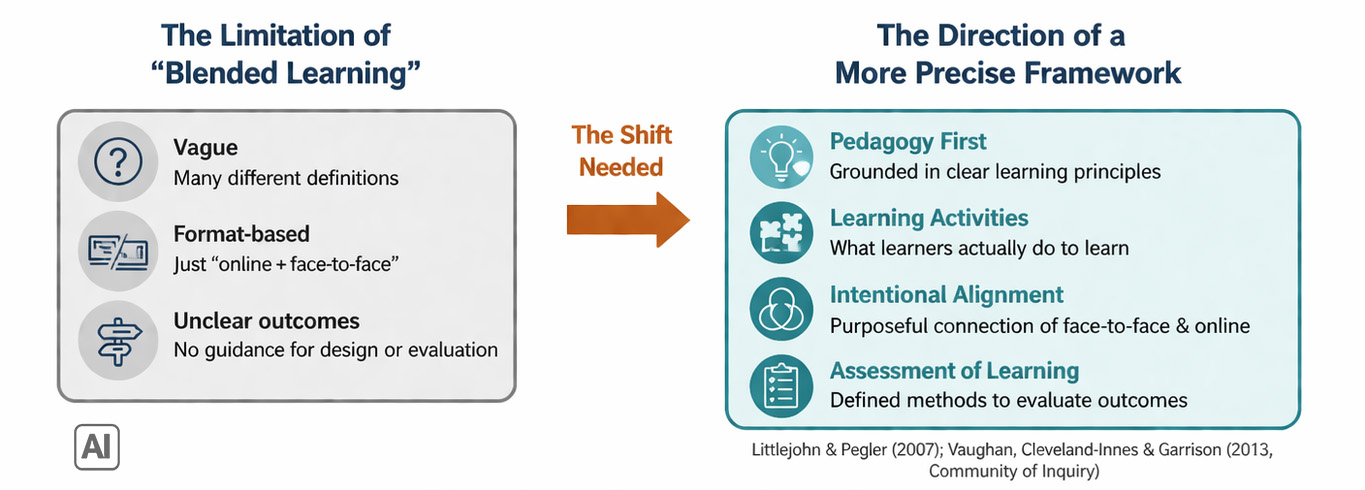
What these approaches share is a shift away from describing the format — online plus face-to-face — towards describing the pedagogical intent. That is the right direction. A framework worth the name should be specific enough to guide decisions, distinguish between good and poor design, and support meaningful evaluation. Blended Learning, as currently defined, does not reliably do any of these things.
8 Lessons Learned & Conclusion
Blended Learning has played a genuinely useful role in opening the conversation about how digital and face-to-face education can work together. That conversation was worth having, and it has produced some valuable insights. But a useful starting point is not the same as a reliable framework.
The core problem is straightforward: Blended Learning is too broad to guide educational design with any precision. It accommodates too many approaches, prescribes too little, and has become too closely tied to institutional branding and policy rhetoric. The term tells us what format a course uses — some online, some face-to-face — but says almost nothing about how or why.
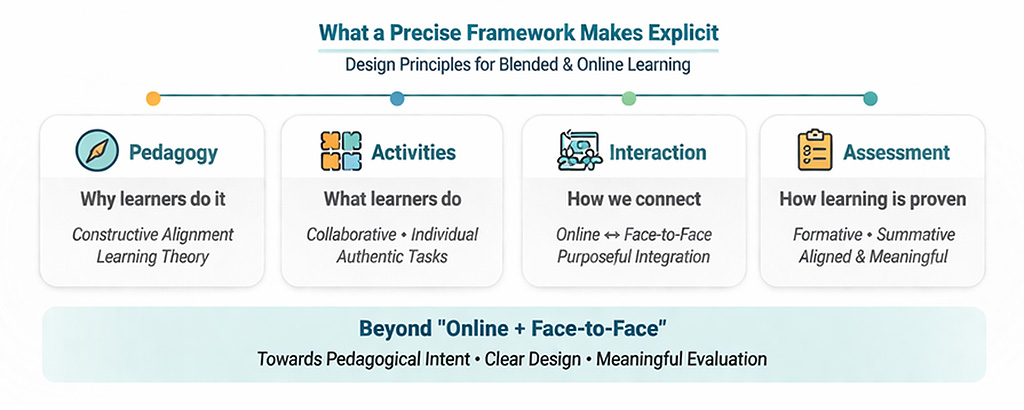
If we are serious about improving the quality of learning — in higher education, in professional training, or in any other context — we need frameworks that are more precise, more pedagogically grounded, and more honest about what they require. The Blended Learning, as a framework, is a useful further development and a promising approach to modern, technology-supported teaching and training. Nevertheless, it will be that what Flipped Learning 3.0 is today.
9 Appendix: Learning Methods
- Constructivism: This is the idea that we learn by doing. You build your own knowledge through experience and by solving problems.
- Instructivism (Lecture-style teaching): This is a more traditional way of learning. A teacher gives you information directly, and you listen to understand the facts.
- Collaborative Learning: This means learning together in a group. You talk to other people to share ideas and help each other understand a topic.
- Flipped Classroom: In this model, you study new material at home first. Then, you use your time in class to do practical work and ask the teacher questions.
10 References
Allen, I. E., & Seaman, J. (2010). Class differences: Online education in the United States, 2010. Babson Survey Research Group / The Sloan Consortium.
Bonk, C. J., & Graham, C. R. (2006). The handbook of blended learning: Global perspectives, local designs. Pfeiffer.
Garrison, D. R., & Kanuka, H. (2004). Blended learning: Uncovering its transformative potential in higher education. Internet and Higher Education, 7(2), 95–105.
Littlejohn, A., & Pegler, C. (2007). Preparing for blended e-learning. Routledge.
Owston, R., & York, D. N. (2018). The nagging question when designing blended courses: Does the proportion of time devoted to online activities matter? Internet and Higher Education, 36, 22–32.
Vaughan, N. D., Cleveland-Innes, M., & Garrison, D. R. (2013). Teaching in blended learning environments: Creating and sustaining communities of inquiry. Athabasca University Press.
 Funded by the European Union. Views and opinions expressed are however those of the author(s) only and do not necessarily reflect those of the European Union or the European Education and Culture Executive Agency (EACEA). Neither the European Union nor EACEA can be held responsible for them.