
When I talk about Flipped Learning, people often expect discussions about videos, self-paced content, or digital tools. But very quickly, the conversation shifts somewhere else. It shifts to what actually happens when learners come together.
Because in Flipped Learning 3.0, the group space is where the real work begins. It is where ideas are exchanged, questions are explored, and understanding is built together. And that makes one thing surprisingly important: how we start.
That is why I find myself coming back to icebreakers.
Not because they are central to the method, but because they reveal something deeper. They show how we think about learning, about participants, and about the purpose of our time together.

Icebreakers in Adult Education: Do We Really Need Them?
The ones where you have to share “two truths and a lie” with a room full of colleagues. The ones where you throw a ball and say your name. The ones where — God forbid — you have to mime something.
And every single time, I’ve watched the faces of the people in the room. Polite smiles. Slightly glazed eyes. A quiet, collective thought: why are we doing this?
That question has stayed with me for years. And after a long time working in adult education, I think it deserves a proper, honest answer.
Across Europe, adult learning happens in very different settings. Different cultures, different expectations, different professional backgrounds. But one thing is always the same: people come to learn, and their time matters. How we start a session matters more than we often realise.
The Uncomfortable Truth About Icebreakers
They’ve become a habit. A ritual. Something you do at the start of a session because, well, that’s what you do. Nobody questions it. Nobody asks whether it actually serves the group, the topic, or the moment.
That bothers me deeply.
When an adult professional — someone who has taken time out of their busy day, possibly travelled, possibly paid for the training themselves — walks into a room and spends the first twenty minutes throwing a ball or drawing their “life as a weather forecast,” something has gone wrong.
That person came to learn. They didn’t come to play a game they last saw at a school camp in 1987.
The research, such as it is, doesn’t exactly help the case for icebreakers either. The evidence that they actually improve learning outcomes is remarkably thin. Most of what gets cited is anecdotal. That might be real. But feelings aren’t proof.
When Icebreakers Go Wrong
I’ve seen the same patterns again and again.
Too many, too often. Using an icebreaker at the start of every session, day after day, stops being energising and starts being exhausting. People begin to dread them.
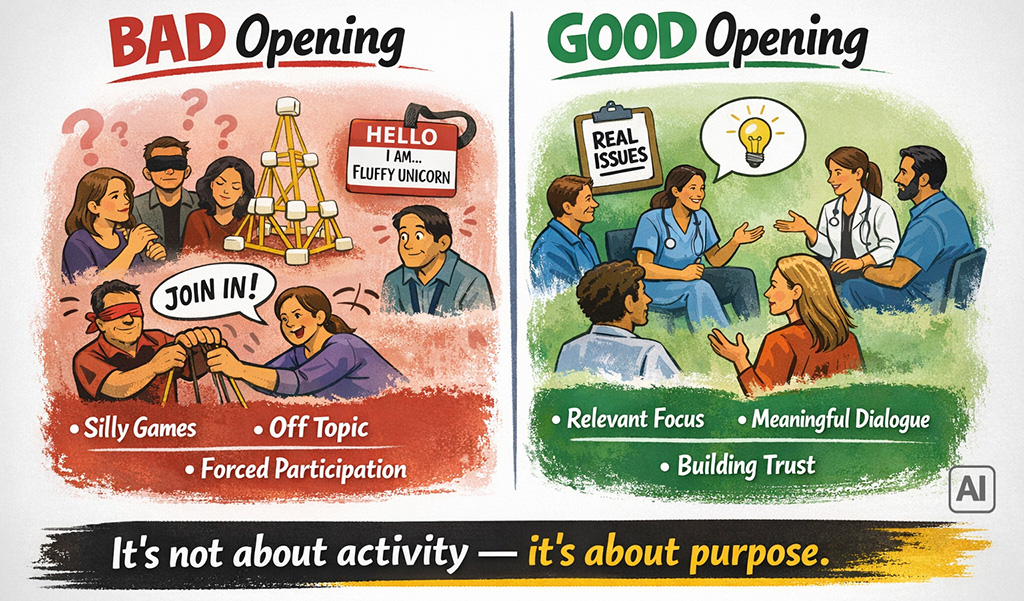
Completely disconnected from the topic. A group of experienced professionals doesn’t need to build a tower out of spaghetti to feel connected. They need something that respects why they are there.
Activities designed for teenagers, used on adults. This breaks trust very quickly. It feels patronising.
Participation that isn’t really optional. When saying “no” feels impossible, we are not creating safety. We are creating pressure.
So When Do Icebreakers Actually Make Sense?
Done well, with intention, they can be useful. But only in the right moment.
For me, that moment is the first meeting of a group — especially in a Flipped Learning 3.0 setting. When people come together after working with content on their own, they arrive with ideas, questions, and experiences. They are ready to work together.
In that situation, a well-designed opener can help build trust and create a shared starting point.
But only once. That’s it.
If you keep using icebreakers again and again, they lose their value. The group has already formed. Move on.
For an icebreaker to be worth the time, it should:
- have a clear purpose
- fit the group
- connect to the topic
- feel genuinely optional
A group of nurses discussing a real communication challenge from their work — that works. Asking them about their “spirit animal” does not.
What About Online?
Online sessions are different.
The small, informal moments that happen naturally in a room don’t exist. There is no chat before things start. No quick conversation in the break.
So yes, in online settings, it can make sense to create space for connection.
But it needs to be done carefully.
Technology already creates distance. Silence feels longer. Not everyone feels comfortable speaking or being on camera. If an activity doesn’t work, it is much harder to recover. Simple tools like short polls, word clouds, or one focused question can work well. But the same rule applies: it needs a purpose, and it needs to feel natural.
So: What Do We Do Instead?
If many traditional icebreakers don’t work, the question becomes simple: what should we do instead?
We don’t need to remove openings. We need to design them better.
A good opening is not an activity. It is a function.
Its job is to help people move into learning, quickly and respectfully.
That might mean asking a question that connects to their experience.
It might mean giving a short moment for reflection.
It might mean a quick exchange in pairs about a real situation from their work.
When it is done well, it doesn’t feel like an “icebreaker”.
It feels like the learning has already started.
What Theory Actually Tells Us
If we look at how adults learn, this all makes sense.
Adults do not come into a room empty. They bring experience, expectations, and a need for relevance. If we ignore that, we lose them early.
Learning also does not start after an activity. It starts immediately. From the first minute, people are already making sense of what is happening.
That means the opening matters. It is not a warm-up. It is part of the learning.
Many trainers use icebreakers to create connection or psychological safety. That intention is important. But safety does not come from forced playfulness. It comes from respect, clarity, and the feeling that participation is real and optional.
Motivation works in a similar way. People engage when they feel that what they are doing makes sense, that they are taken seriously, and that they have some control over their participation.
In Flipped Learning 3.0, this becomes even clearer. When learners arrive prepared, the group space is not there to “get started”. It is there to think, discuss, and work together. A poorly chosen icebreaker can interrupt that process.
These ideas are not new. Malcolm Knowles showed that adult learning depends on experience and relevance. Piaget and Bruner described learning as an active process of making meaning. Vygotsky highlighted the importance of meaningful interaction. Kolb connected learning to real experience and reflection. Deci and Ryan showed how motivation depends on autonomy, competence, and connection.
All of this points in the same direction.
Good openings do not “break the ice”.
They help people start learning.
Rethinking Icebreakers for the Future
Maybe the real question is not: What is a good icebreaker?
Maybe the real question is: What does this group need right now to start learning well?
But often, it won’t.
Sometimes, the best start is a good question.
Sometimes, it is a brief moment to think.
Sometimes, it is simply starting clearly and getting into the topic.
As educators, we have a responsibility here.
We should be able to explain why we do what we do. Not with vague ideas about “energy”, but with a clear link to learning.
If an activity does not serve that, it does not belong.

A Final Thought
In the end, this is not really about icebreakers.
It is about intention. It is about whether we design learning for the people in the room — or for our own habits. Participants notice. They know when something is meaningful, and when it is not.
If you are going to use an icebreaker, make it count.
If you can’t explain, in one sentence, why this activity helps this group learn at this moment — then maybe the best thing you can do is simply start.
A Note on Terminology
To avoid confusion, here is how I use these terms:
Icebreaker
An activity to help people get to know each other and feel more comfortable in a new group.
Opener
A starting activity that connects directly to the topic and helps begin the learning process.
Energiser
A short activity used during a session to bring energy back.
Check-in
A brief moment at the start where participants share how they are or what they expect.
Transition activity
A short activity that helps move from one part of a session to another.
This article was published as part of the BonJou! project, which included a series of training sessions for coaches, media educators, and interested adults.
 Funded by the European Union. Views and opinions expressed are however those of the author(s) only and do not necessarily reflect those of the European Union or the European Education and Culture Executive Agency (EACEA). Neither the European Union nor EACEA can be held responsible for them.