
The last project where EBI was partner was challenging, very interesting, finished successfully, and full of lessons learned. Building on this experience, the following reflection explores the key factors that shaped collaboration and project success. It focuses on the dynamic relationship between trust, communication, and collaboration as a self-reinforcing system in project management.
1. Introduction
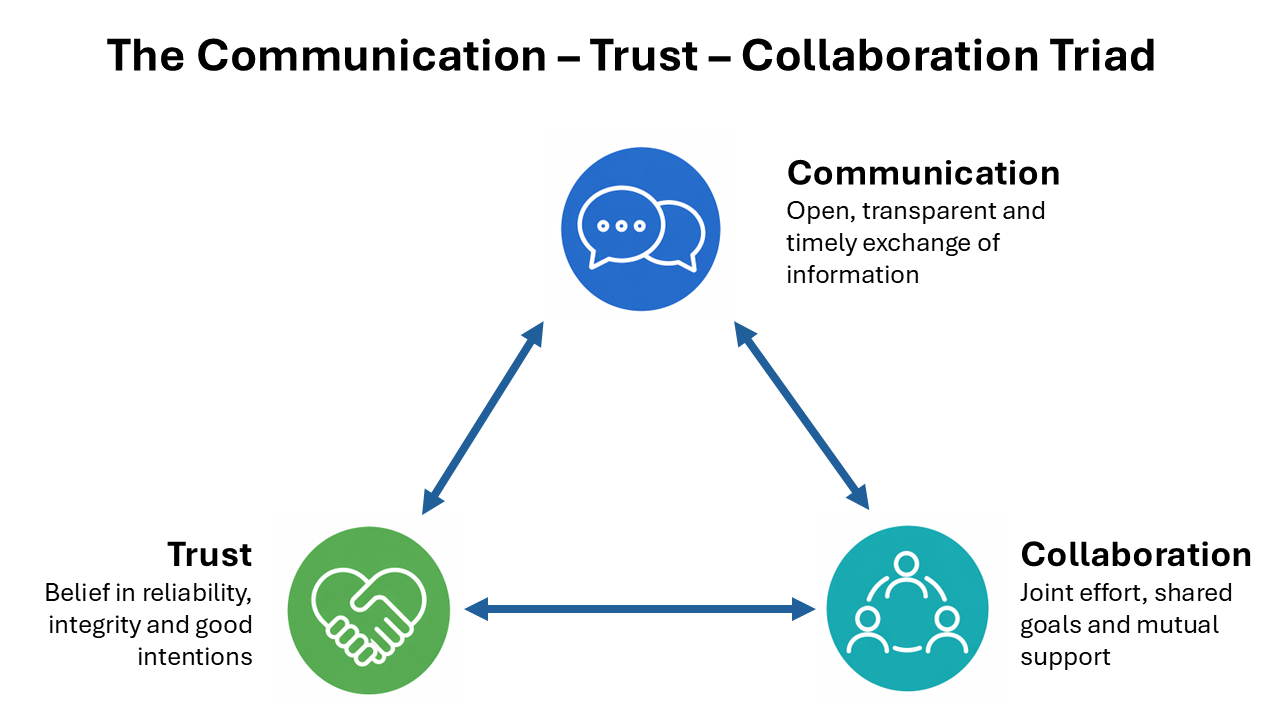
Trust, communication, and collaboration are widely seen as key success factors in project management. They are often presented as three equal elements of a triangle. However, a closer analysis shows that their relationship is more complex.
These three elements form a dynamic, self-reinforcing system, where each element is both cause and effect. At the same time, they take on different functional roles:
- Trust forms the foundation
- Communication acts as the connecting and coordinating mechanism
- Collaboration represents the outcome and value creation
This system is not linear, but circular, with both positive and negative feedback loops.
2. Trust as the Foundation of the System
Trust is the basic condition for effective interaction in a project environment. It reduces uncertainty and enables coordinated action in complex situations.
2.1 Dimensions of Trust
Trust in teams can be divided into three main dimensions:
- Competence-based trust: belief that others are capable of doing their job
- Benevolence-based trust: belief that others have good intentions
- Integrity-based trust: belief that others act in a consistent and reliable way
All three dimensions are necessary for stable collaboration.
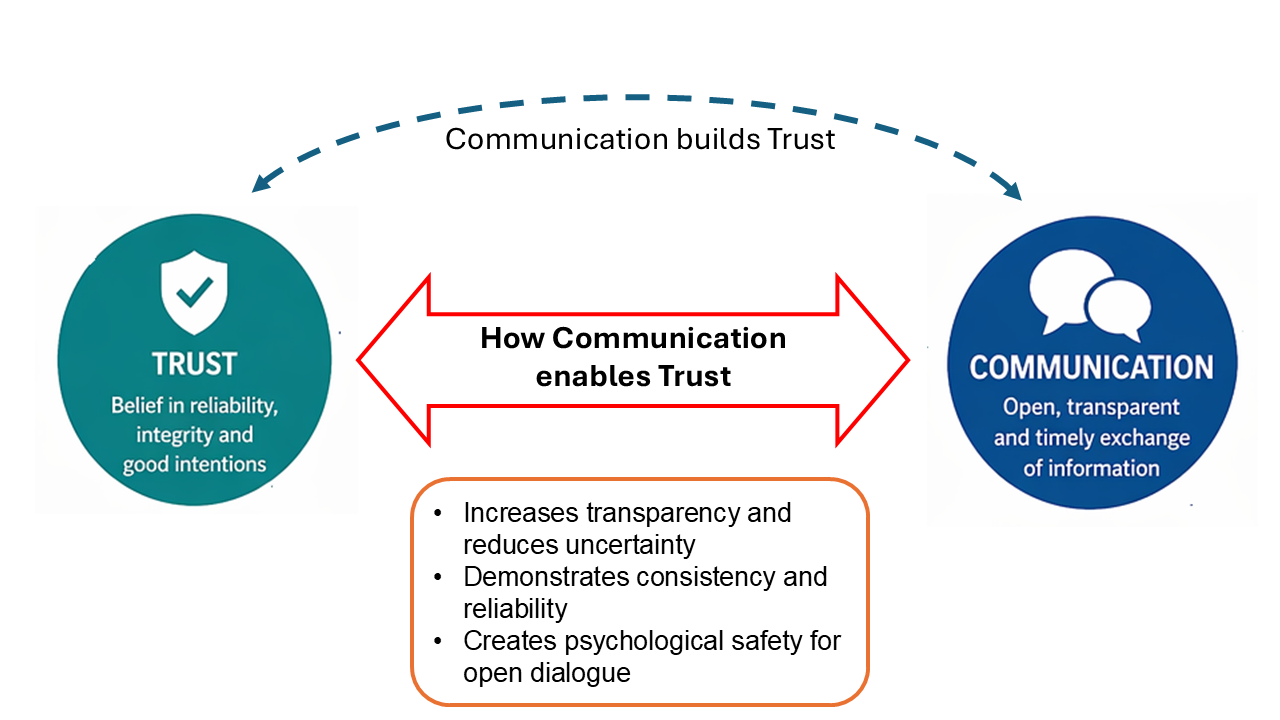
2.2 Impact of Trust on Communication
Trust directly shapes the quality of communication:
- In high-trust environments, communication is open, honest, and timely
- Problems are addressed early, before they escalate
- Mistakes can be discussed without fear
When trust is low:
- Information is withheld or distorted
- Status reports are overly positive
- so-called “political silence” emerges
As a result, communication is not only reduced, but also systematically biased.
2.3 Impact of Trust on Collaboration
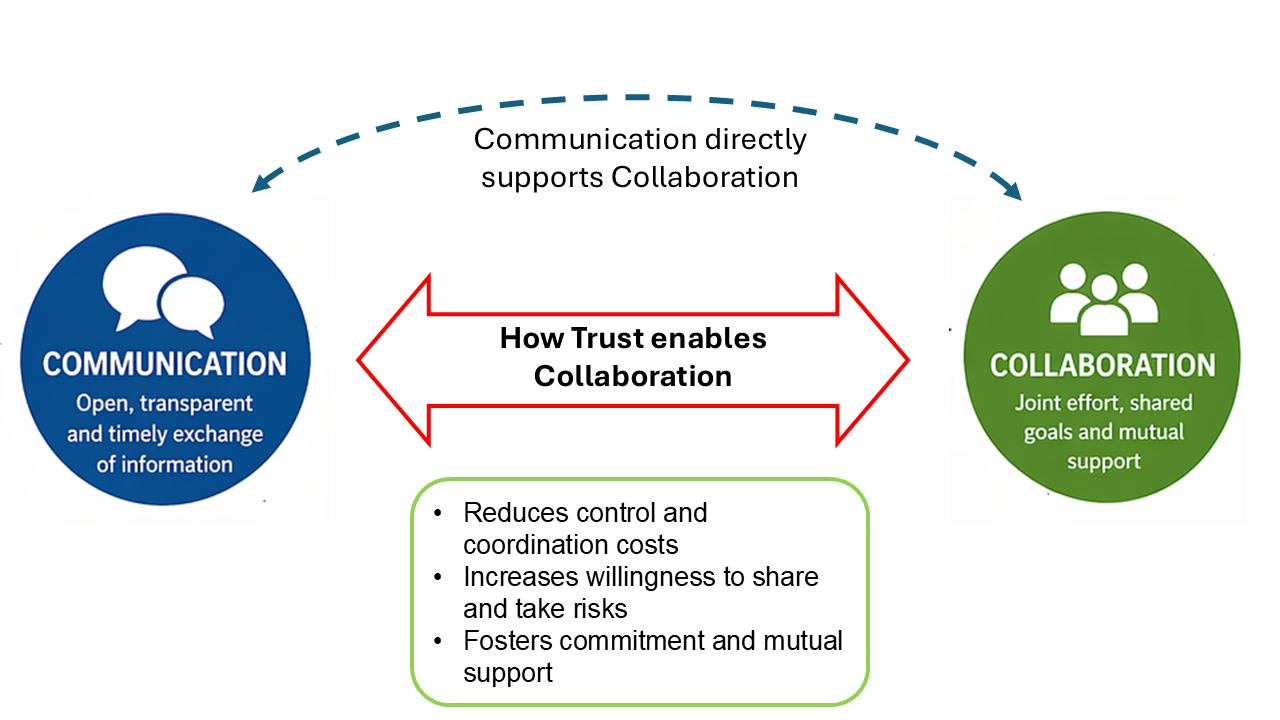
Trust is essential for real collaboration:
- It increases willingness to take risks
- It encourages sharing of ideas and knowledge
- It makes it easier to ask for help
In project settings, this often leads to “swift trust”, where people collaborate quickly based on perceived competence.
Without trust, collaboration becomes superficial and turns into parallel individual work with formal coordination.
3. Communication as the Nervous System
Communication is the operational core of the system. It connects people, transfers information, and makes both trust and collaboration visible.
3.1 The Dual Role of Communication
Communication has two roles:
- It is a tool used to coordinate work
- It is also a signal that builds or destroys trust
Therefore, communication is never neutral — it always has an effect.
3.2 Impact of Communication on Trust
Trust develops through repeated communication experiences:
- clear and consistent messages
- transparent sharing of information
- reliable follow-up
Alignment between words and actions is especially important.
Trust is damaged by:
- lack of communication (“information gaps”)
- inconsistent messages
- deliberately withheld information
Even a single negative event can quickly destroy trust that took a long time to build.
3.3 Impact of Communication on Collaboration
Collaboration cannot exist without communication.
Effective communication provides:
- clear goals
- defined roles
- aligned expectations
It creates a shared understanding of the situation, often called a “shared mental model”.
This shared understanding is essential for coordinated and efficient work.
4. Collaboration as Outcome and Reinforcer
Collaboration is where actual value is created. It combines different skills to solve problems and achieve goals.
4.1 Impact of Collaboration on Trust
Successful collaboration strengthens trust:
- team members experience each other’s reliability
- individual strengths become visible
- mutual support becomes tangible
Shared success, especially under pressure, builds strong and lasting trust.
This experience-based trust is often more robust than purely cognitive trust.
4.2 Impact of Collaboration on Communication
As collaboration increases, communication evolves:
- teams develop a shared language
- coordination becomes faster
- implicit knowledge grows
This improves efficiency, but can also create risks, such as groupthink or blind spots.
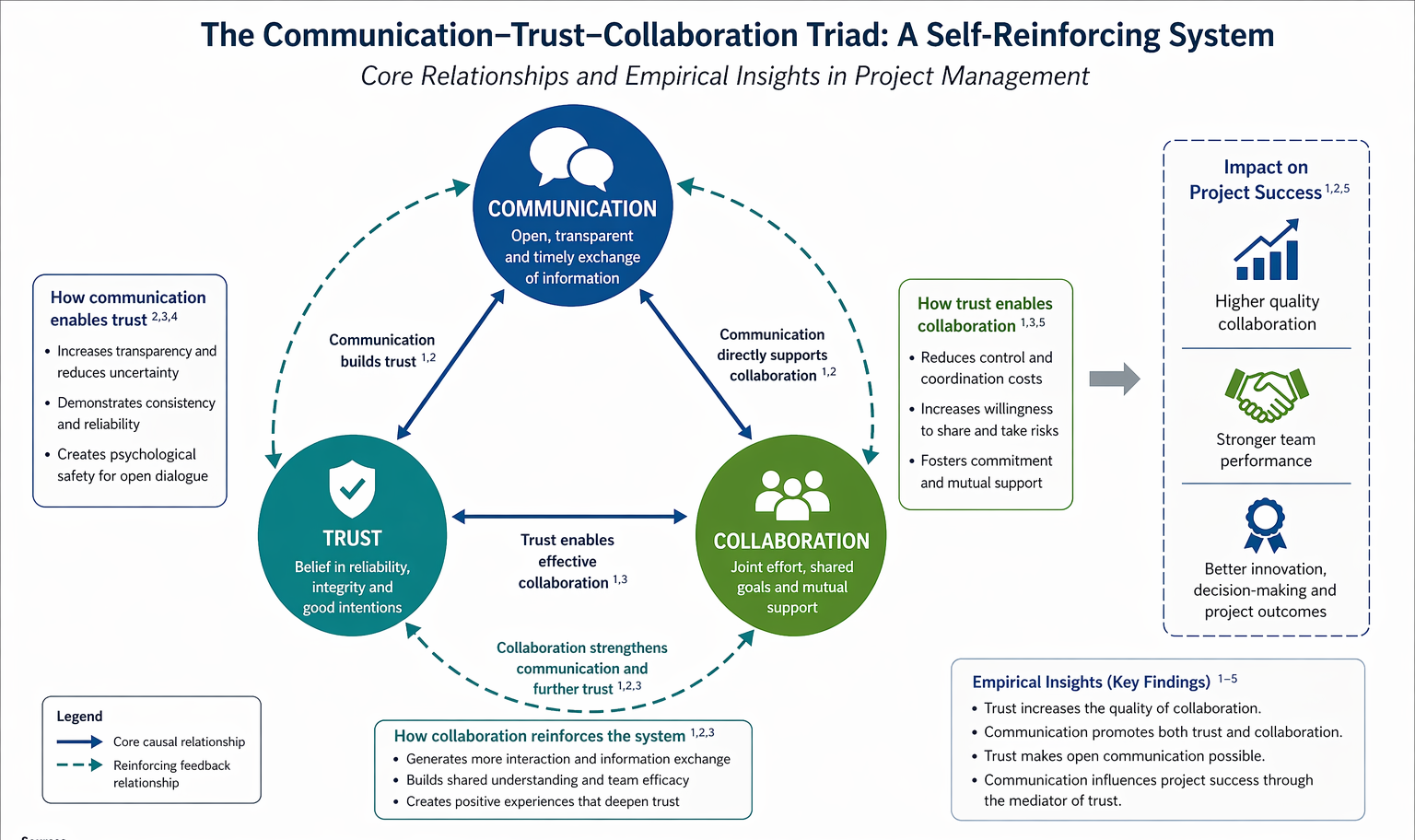
5. Core System Dynamics: Reinforcing Loops
The three elements form a system with feedback loops.
5.1 Positive Spiral (Virtuous Cycle)
- Good communication builds trust
- Trust enables effective collaboration
- Successful collaboration strengthens trust further
- Communication becomes more open and efficient
The system reinforces itself and becomes stable.
5.2 Negative Spiral (Vicious Cycle)
- Poor communication leads to misunderstandings
- Misunderstandings reduce trust
- Collaboration breaks down
- Conflicts increase
- Communication becomes even weaker
The system destabilises and may collapse quickly.
6. Interdependency of the Elements
Not only the individual elements, but also their combinations, are important:
- Trust + Communication → creates psychological safety
- Communication + Collaboration → leads to operational efficiency
- Trust + Collaboration → builds resilience
These combinations show that outcomes depend on how the elements work together.
7. Overall Model and Interpretation
The system can be described with a simple metaphor:
- Trust is the root
- Communication is the trunk
- Collaboration is the fruit
At the same time, the fruit feeds back into the root because successful collaboration strengthens trust.
The system is, therefore:
- circular
- dynamic
- non-linear
8. Practical Implications for Project Management
This analysis leads to several practical insights:
1. Actively build trust
-
-
- through consistent behaviour
- by fostering psychological safety
-
2. Design communication carefully
-
-
- clear, regular, and transparent
- seen as a strategic tool, not just administration
-
3. Support collaboration deliberately
-
-
- through shared goals
- through early joint successes
-
4. Watch for system signals
-
-
- reduced openness
- more formal and defensive communication
- declining real collaboration
-
These are often signs of more profound system issues.
9. Some Takeaways for Future Projects
Trust, communication, and collaboration are not independent success factors. They form a tightly connected system with clear roles and mutual influence.
The core relationship is:
- Trust enables open communication
- Communication enables coordinated collaboration
- Collaboration creates results and strengthens trust
This creates a self-reinforcing cycle that can develop in both positive and negative directions.
The key to successful project management is therefore not to optimise a single element, but to actively manage the system as a whole.
Sources and used Background Information
- Bond-Barnard, T. J., Fletcher, L., & Steyn, H. (2018). Linking trust and collaboration in project teams to project management success. International Journal of Managing Projects in Business, 11(2), 432–457. https://doi.org/10.1108/IJMPB-06-2017-0068
- Pinto, J. K., & Slevin, D. P. (1987). Critical factors in successful project implementation. IEEE Transactions on Engineering Management, 34(1), 22–27. https://doi.org/10.1109/TEM.1987.6498856
- Dirks, K. T., & Ferrin, D. L. (2002). Trust in leadership: Meta-analytic findings and implications for research and practice. Journal of Applied Psychology, 87(4), 611–628. https://doi.org/10.1037/0021-9010.87.4.611
- Edmondson, A. C. (1999). Psychological safety and learning behavior in work teams. Administrative Science Quarterly, 44(2), 350–383. https://doi.org/10.2307/2666999
- Nahapiet, J., & Ghoshal, S. (1998). Social capital, intellectual capital, and the organizational advantage. Academy of Management Review, 23(2), 242–266. https://doi.org/10.5465/amr.1998.533225
 Funded by the European Union. Views and opinions expressed are however those of the author(s) only and do not necessarily reflect those of the European Union or the European Education and Culture Executive Agency (EACEA). Neither the European Union nor EACEA can be held responsible for them.