Beyond Delivery: An Andragogical Approach to Digital Media Literacy for Adults 55+

The BonJour training course for adults aged 55+ is designed to use Blended Learning as its main delivery format. Blended Learning combines face-to-face and online learning elements and offers flexibility for adult learners.
However, Blended Learning in itself is primarily a method of delivering content rather than a complete educational approach. It defines how learning is organised, but not how learning should be designed in a meaningful and effective way.
In particular, Blended Learning does not provide a clear andragogical foundation that addresses the specific needs of adult learners aged 55 and over. It also lacks essential elements of a comprehensive framework, such as clearly defined learning objectives, pedagogical strategies, learner engagement methods, and structured guidance for educators.
As a result, there is a risk that Blended Learning remains a technical solution rather than a high-quality educational experience. To ensure effectiveness, inclusiveness, and sustainability, Blended Learning must therefore be embedded within a structured andragogical framework that supports both learners and educators in a coherent and purposeful way. This article describes the “BonJour!” andragogical framework for adult learning 55+
Theoretical Foundations of the Planning Model (Andragogical Approach)
The planning model used in BonJour draws on a well-established tradition in didactic theory, adapting it specifically for adult and older learners. Its structure reflects the Berlin Model (Berliner Modell) developed by Paul Heimann, Gunter Otto, and Wolfgang Schulz in the 1960s — one of the most influential frameworks for the systematic analysis and planning of teaching and learning processes (Heimann, Otto & Schulz, 1965).
The Berlin Model as a Foundation
The Berlin Model holds that any learning situation is shaped by a set of interdependent factors: no single element can be planned or changed in isolation because each affects all the others.
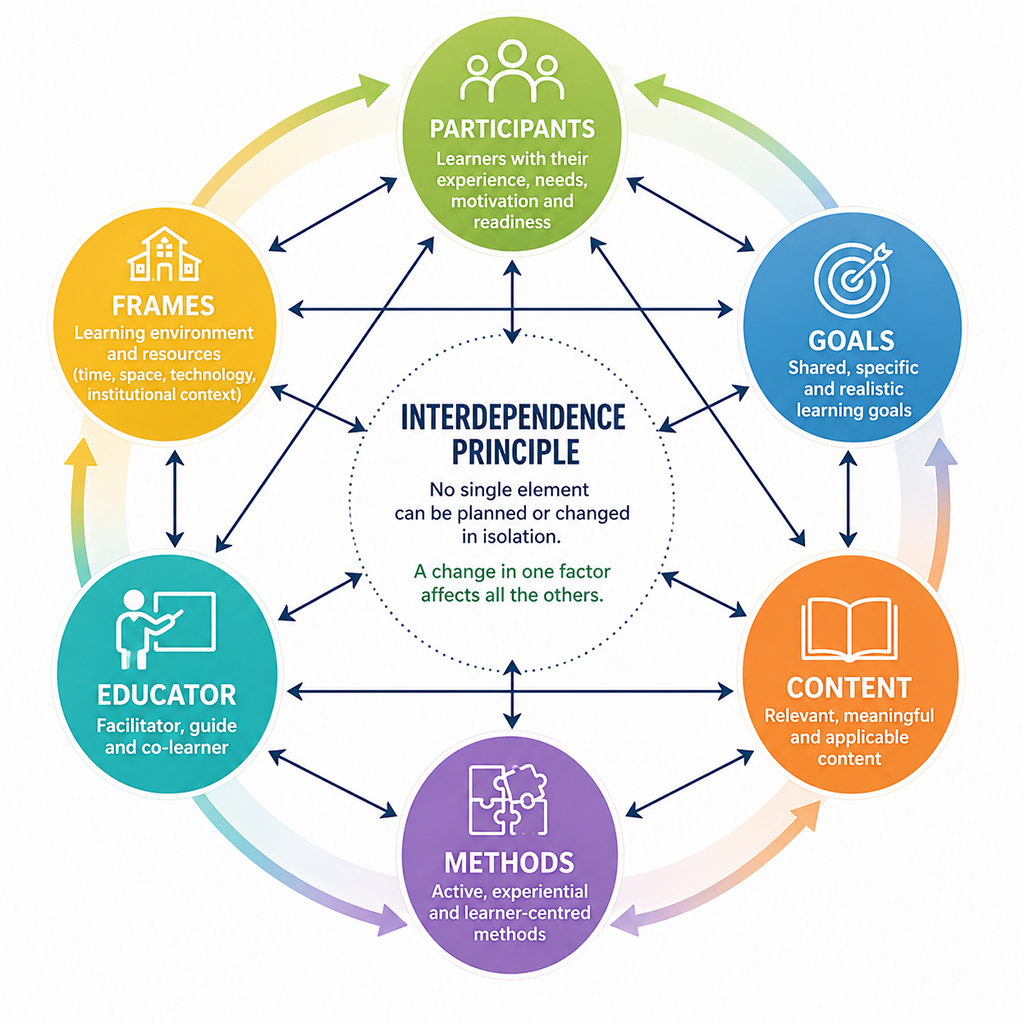
This principle of interdependence (Interdependenzannahme) is central to the model’s logic. It distinguishes between two categories of factors:
- Condition fields (Bedingungsfelder) — the given circumstances that frame the learning situation, such as the learners’ prior knowledge, motivation, and the institutional or material context.
- Decision fields (Entscheidungsfelder) — the elements over which the educator exercises active professional judgement: goals, content, methods, and media.
Rational, reflective planning — rather than intuitive or ad hoc decision-making — is the explicit aim of this model. Educators are expected to be able to articulate and justify every choice they make, and to recognise that a change in one factor necessarily calls for a reconsideration of all the others.
Adaptation for Adult and Older Learners
The BonJour planning model translates the six factors of the Berlin Model into a framework shaped by the principles of andragogy (Knowles, 1980) and geragogy. Where the Berlin Model was originally developed for formal schooling, BonJour applies its logic to adult education settings — and specifically to older learners, who bring greater heterogeneity in prior experience, health, digital familiarity, and emotional readiness than younger student populations.
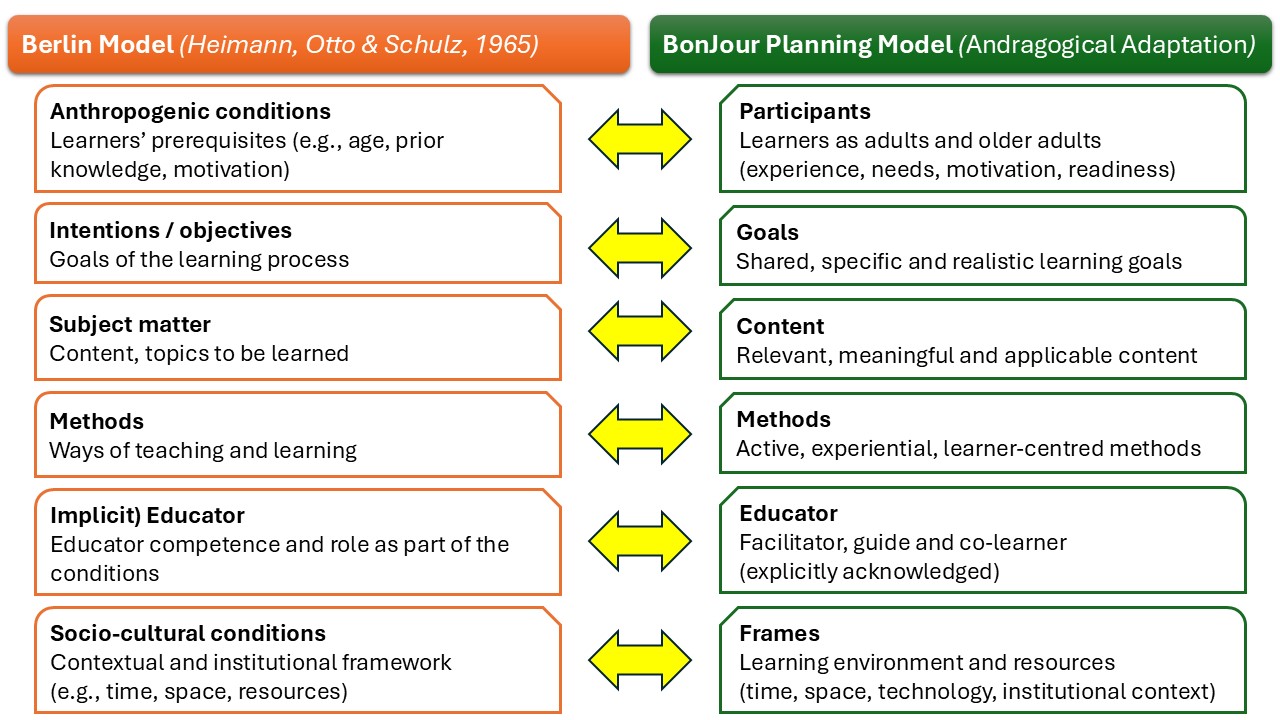
The correspondence between the two frameworks is as follows, showing the German terms as defined from the authors:
| BonJour Planning Model | Berlin Model |
| Participants | Anthropogenic conditions (Lernvoraussetzungen) |
| Goals | Intentions / objectives (Ziele) |
| Content | Subject matter (Inhalte) |
| Methods | Methods (Methoden) |
| Educator | (implicit condition: educator competence and role) |
| Frames | Socio-cultural conditions (Rahmenbedingungen) |
Participants corresponds to what the Berlin Model calls anthropogenic prerequisites — the learners’ age, prior knowledge, motivation, and needs. In an andragogical context, this factor carries particular weight: adults are self-directed, experience-rich learners, and any planning that ignores who they are and what they bring to the room is likely to fail. For older learners, this includes awareness of potential anxieties around cognitive decline, digital competence, or social judgement.
Goals maps directly onto the Berlin Model’s Intentionen. In adult education, objectives must be specific, realistic, and — critically — shared with and accepted by the participants themselves. Adults learn best when they understand and agree with the purpose of what they are doing.
Content corresponds to the decision field of Inhalte. For andragogical settings, content selection is guided not only by subject logic but by relevance to learners’ actual lives. Content that cannot be connected to real experience or immediate application is unlikely to engage adult learners effectively.
Methods maps onto the Berlin Model’s Methoden. The choice of method must be coherent with both the goals and the content — and must be appropriate for adult learners who expect to be active participants, not passive recipients. BonJour structures its sessions around Kolb’s experiential learning cycle, ensuring that method always begins with lived experience and moves towards practical application.
Educator is not an explicit decision field in the original Berlin Model but is implicitly embedded in both condition fields: the educator’s competence, attitude, and role are part of the conditions that shape the learning situation. In the BonJour model, this factor is made explicit, reflecting the reality that the quality of facilitation — including the decision to work with a co-facilitator — directly determines what is possible in any given session.
Frames corresponds to the Berlin Model’s socio-cultural prerequisites (soziokulturelle Voraussetzungen): the available time, physical or digital space, equipment, and institutional context. These are the conditions the educator cannot change but must account for in every planning decision.
Planning as a Dynamic, Interdependent Process
What the Berlin Model contributes above all is a reminder that planning is not linear. It is not a matter of setting a goal and then selecting content and methods in sequence. Every factor conditions every other. If the participant group changes — say, a session planned for confident digital users must now accommodate complete beginners — then goals, content, methods, and the demands placed on the educator all shift accordingly.
This dynamic, systemic view of planning is especially valuable in adult and older learner contexts, where heterogeneity is the rule rather than the exception, and where rigid lesson plans are particularly likely to break down. The BonJour! planning model is designed to support educators in thinking through these interdependencies deliberately and reflectively — before, during, and after each session.
The Flipped Learning 3.0 Framework for content delivering
Flipped Learning 3.0 is an advanced framework that extends traditional Blended Learning to a complete training framework beyond simple content delivery. While Blended Learning focuses on combining online and face-to-face formats, Flipped Learning 3.0 enables a strong pedagogical and andragogical foundation. It ensures that learning is not only accessible, but also meaningful, structured, and learner-centred. Additionally, it enables to use any consistent pedagogy.
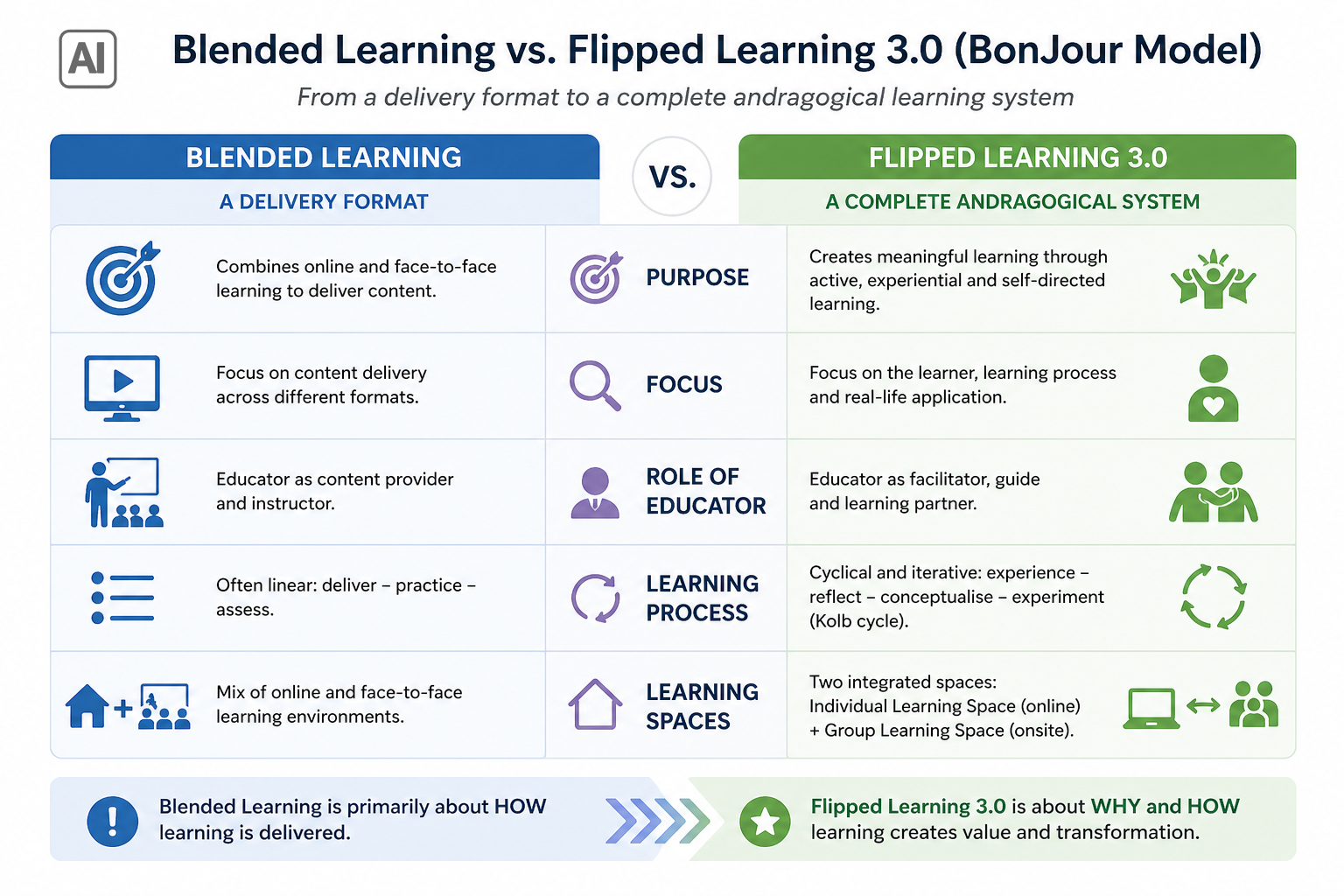
At its core, Flipped Learning 3.0 integrates clear learning objectives, competence-based design, and active learning processes. It places the learner at the centre and supports self-directed learning, collaboration, and reflection. In addition, the framework connects digital tools, teaching methods, and assessment strategies in a coherent way. This creates a structured learning experience that supports both educators and adult learners, especially those aged 55 and over.
Merging Flipped Learning 3.0 with the Andragogical Model
The Berlin Model provides a structured approach to planning teaching and learning processes through its key elements: intentions, content, methods, media, and contextual conditions. The Flipped Learning 3.0 framework complements this structure by adding a strong learner-centred, competence-based, and digitally supported approach.
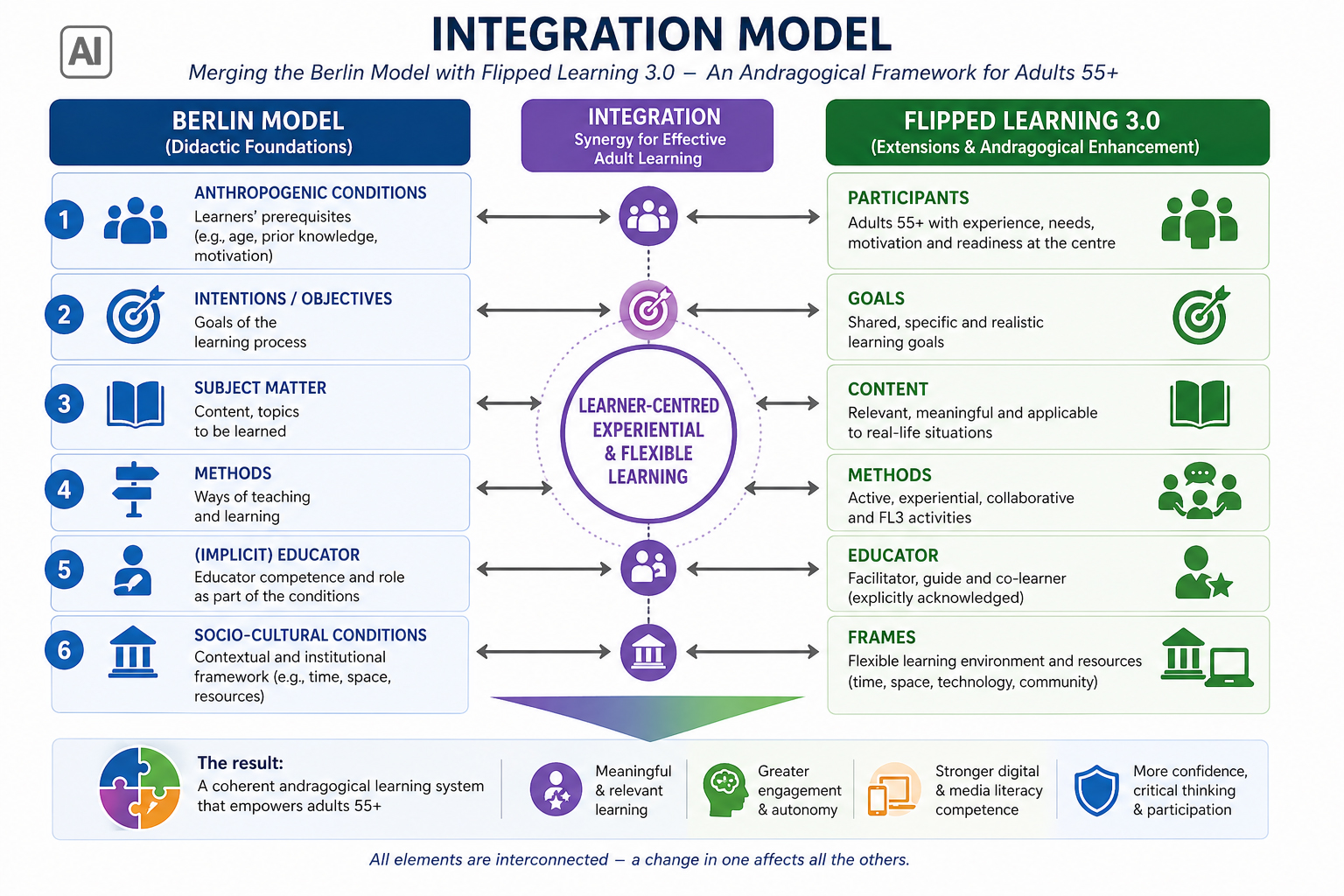
The following section explains how both models can be effectively connected.
1. Intentions ↔ Competence-Based Learning and Learning Outcomes
In the Berlin Model, intentions define the goals of the learning process.
Flipped Learning 3.0 extends this by focusing on clearly defined, competence-based learning outcomes that describe what learners are able to do in real-life situations. This ensures that learning is practical, relevant, and aligned with adult learners’ needs. For adults aged 55+, this includes not only knowledge acquisition but also confidence, autonomy, and digital participation.
2. Content ↔ Microlearning and Structured Learning Pathways
Content in the Berlin Model refers to the selection and organisation of learning material. Flipped Learning 3.0 enhances this through microlearning units and clearly structured learning pathways. Content is broken down into small, manageable elements that are easier to understand and more accessible for adult learners. It uses the two learning spaces: Individual Learning Space (Learning Platform) and Group Learning Space (Onsite training).
This approach supports flexibility and allows learners to progress at their own pace.
3. Methods ↔ Flipped Learning and Active Learning Processes
Methods in the Berlin Model describe how teaching and learning take place.
Blended Learning 3.0 integrates the principles of Flipped Learning, where learners first engage with content individually and then apply knowledge in interactive, group-based settings. This shifts the focus from passive reception to active participation. It encourages discussion, collaboration, and problem-solving, which are essential for meaningful adult learning.
4. Media ↔ Digital Tools and Learning Platforms
Media in the Berlin Model includes all tools and materials used in the learning process.
Flipped Learning 3.0 expands this by integrating digital tools, multimedia content, and online learning platforms. These tools are not used for their own sake, but to support engagement, accessibility, and different learning preferences. For learners aged 55+, this also includes guidance and support to build digital confidence.
5. Anthropogenic Conditions ↔ Learner-Centred Design and Inclusion
The Berlin Model considers learners’ individual characteristics, such as prior knowledge, motivation, and abilities.
Flipped Learning 3.0 strengthens this by applying a learner-centred and inclusive design approach. Learning is adapted to diverse needs, including different learning speeds, digital skills, and personal backgrounds. This is particularly important for older adults, who may have very different experiences with learning and technology.
6. Socio-Cultural Conditions ↔ Flexible and Accessible Learning Environments
Socio-cultural conditions in the Berlin Model refer to the broader learning context, such as institutional settings and available resources.
Flipped Learning 3.0 responds to this by creating flexible and accessible learning environments that combine online and offline elements. This allows learning to take place in different settings and supports participation regardless of time, location, or personal circumstances.
Appendix
Here is a brief compilation of the main scientists with their contributions to a modern didactical approach. In the BonJour! Model we created the andragogical model out of their findings and publications.
Malcolm Knowles (1913–1997) was an American educator and theorist whose work fundamentally shaped the field of adult education in the English-speaking world. As a professor at Boston University and later North Carolina State University, he developed the theory of andragogy — the art and science of teaching adults — as a distinct discipline, contrasting it explicitly with the pedagogy of children. His central work, The Adult Learner: A Neglected Species (1973, revised as The Adult Learner, 1990), argued that adults are self-directed, experience-rich learners motivated primarily by internal goals, and that they learn most effectively when content is immediately relevant to their lives and needs.
David A. Kolb (born 1939) is an American educational theorist and professor emeritus at Case Western Reserve University, Cleveland. Drawing on the work of John Dewey, Jean Piaget, and Kurt Lewin, he developed the theory of experiential learning, proposing that effective learning occurs through a continuous four-phase cycle of concrete experience, reflective observation, abstract conceptualisation, and active experimentation. His foundational text, Experiential Learning: Experience as the Source of Learning and Development (1984), remains one of the most widely cited works in educational theory and has been applied extensively in adult education, management training, and professional development.
Paul Heimann (1901–1967) was a German educationalist and professor at the Free University of Berlin, where he developed what became known as the Berlin Model of didactic planning. His central contribution was the systematic analysis of teaching as a structured interplay of mutually dependent factors — goals, content, methods, media, learner prerequisites, and contextual conditions. His foundational work, co-authored with Otto and Schulz, Unterricht – Analyse und Planung (1965), remains a key reference in German-language didactics (Heimann, P., Otto, G., & Schulz, W. (1965). Unterricht – Analyse und Planung. Schroedel).
Gunter Otto (1927–1999) was a professor of art education and general didactics, closely associated with Heimann’s work at the Free University of Berlin. He contributed significantly to the theoretical refinement of the Berlin Model and to its application in aesthetic and cultural education. His collaboration with Heimann and Schulz helped establish the model as a widely used tool for teacher training and curriculum reflection in the German-speaking world.
Wolfgang Schulz (1929–1993) was a professor of education in Hamburg, who later developed the Berlin Model further into the Hamburger Modell, placing greater emphasis on learner emancipation and the social dimensions of teaching. His work bridges systematic planning and critical-reflective pedagogy, making the model more responsive to the lived realities of diverse learner groups.
The most direct theoretical bridge between the Berlin Model and the BonJour planning framework is provided by Horst Siebert (1939–2022), emeritus professor of adult education at the University of Hanover. In his widely used guide Methoden für die Bildungsarbeit (4th ed., Bielefeld: wbv, 2010), Siebert proposes that method selection in adult education must consider the institutional framework, the participants, the goals and content, and the educator — a set of criteria that maps directly onto the BonJour planning model and confirms the continued relevance of the Berlin Model’s interdependence principle for non-formal adult learning contexts.
A parallel contribution, in the adjacent field of higher education, came from Wolff-Dietrich Webler, long-serving director of the Interdisciplinary Centre for Higher Education Didactics (IZHD) at the University of Bielefeld. Working within universities rather than community education settings, Webler developed a similarly systematic approach to reflective teaching and learning design — one that informed, in a modest but tangible way, the broader thinking behind the BonJour model.