Author: PeterMaz

Beyond Delivery: An Andragogical Approach to Digital Media Literacy for Adults 55+

Beyond Delivery: An Andragogical Approach to Digital Media Literacy for Adults 55+

The BonJour training course for adults aged 55+ is designed to use Blended Learning as its main delivery format. Blended Learning combines face-to-face and online learning elements and offers flexibility for adult learners.
However, Blended Learning in itself is primarily a method of delivering content rather than a complete educational approach. It defines how learning is organised, but not how learning should be designed in a meaningful and effective way.

In particular, Blended Learning does not provide a clear andragogical foundation that addresses the specific needs of adult learners aged 55 and over. It also lacks essential elements of a comprehensive framework, such as clearly defined learning objectives, pedagogical strategies, learner engagement methods, and structured guidance for educators.

As a result, there is a risk that Blended Learning remains a technical solution rather than a high-quality educational experience. To ensure effectiveness, inclusiveness, and sustainability, Blended Learning must therefore be embedded within a structured andragogical framework that supports both learners and educators in a coherent and purposeful way. This article describes the “BonJour!” andragogical framework for adult learning 55+

Theoretical Foundations of the Planning Model (Andragogical Approach)

The planning model used in BonJour draws on a well-established tradition in didactic theory, adapting it specifically for adult and older learners. Its structure reflects the Berlin Model (Berliner Modell) developed by Paul Heimann, Gunter Otto, and Wolfgang Schulz in the 1960s — one of the most influential frameworks for the systematic analysis and planning of teaching and learning processes (Heimann, Otto & Schulz, 1965).

The Berlin Model as a Foundation

The Berlin Model holds that any learning situation is shaped by a set of interdependent factors: no single element can be planned or changed in isolation because each affects all the others.
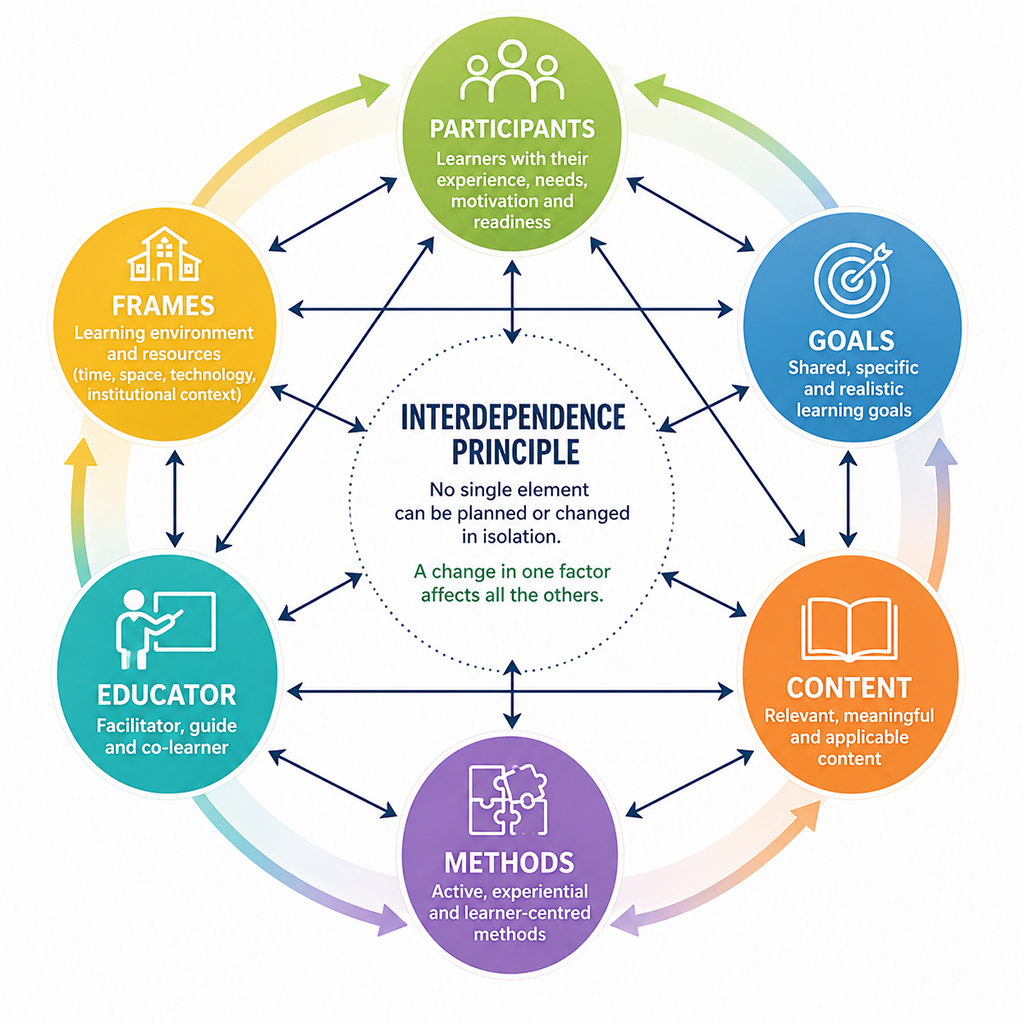
Interdependence Principle in the BonJour Planning Model
This diagram illustrates the core principle that all elements of the learning process—Participants, Goals, Content, Methods, Educator, and Frames—are interconnected and mutually influential. No single element can be planned or adapted in isolation; a change in one factor requires adjustments in all others. The visual highlights the systemic nature of educational planning, which is central to the Berlin Model and essential for reflective and effective practice in adult education.

This principle of interdependence (Interdependenzannahme) is central to the model’s logic. It distinguishes between two categories of factors:

  • Condition fields (Bedingungsfelder) — the given circumstances that frame the learning situation, such as the learners’ prior knowledge, motivation, and the institutional or material context.
  • Decision fields (Entscheidungsfelder) — the elements over which the educator exercises active professional judgement: goals, content, methods, and media.

Rational, reflective planning — rather than intuitive or ad hoc decision-making — is the explicit aim of this model. Educators are expected to be able to articulate and justify every choice they make, and to recognise that a change in one factor necessarily calls for a reconsideration of all the others.

Adaptation for Adult and Older Learners

The BonJour planning model translates the six factors of the Berlin Model into a framework shaped by the principles of andragogy (Knowles, 1980) and geragogy. Where the Berlin Model was originally developed for formal schooling, BonJour applies its logic to adult education settings — and specifically to older learners, who bring greater heterogeneity in prior experience, health, digital familiarity, and emotional readiness than younger student populations.
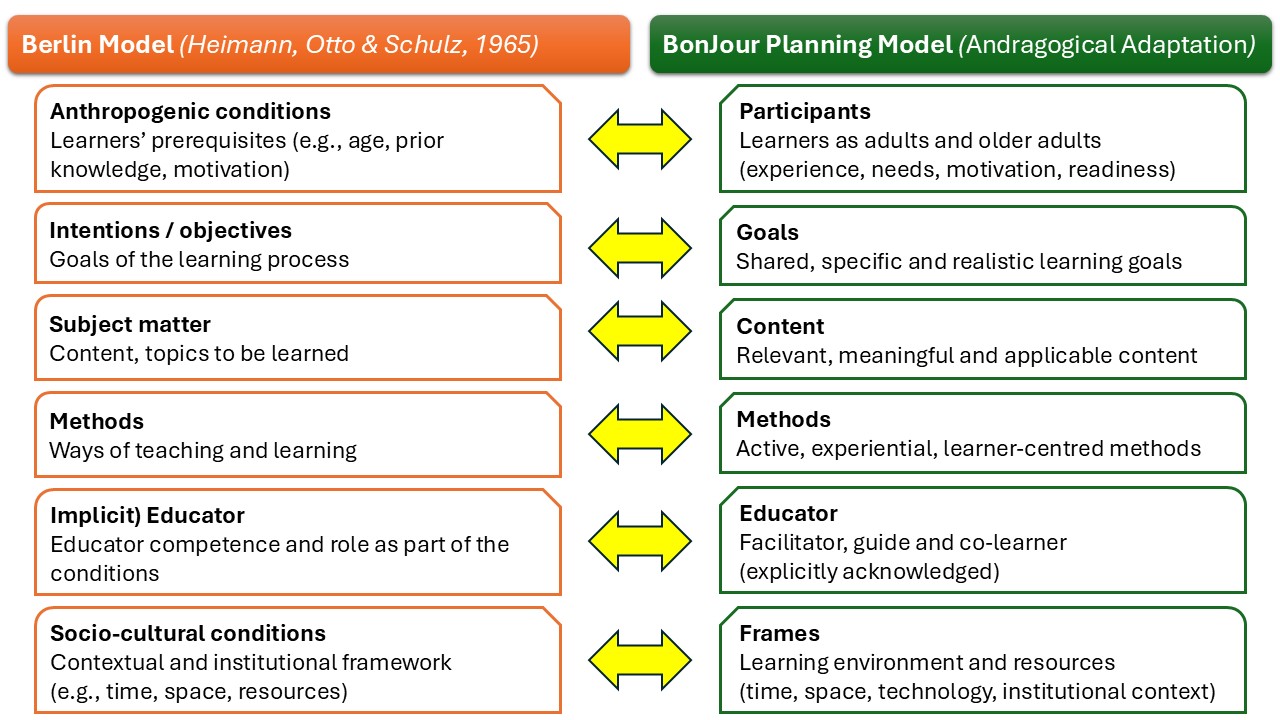
Comparative Mapping Diagram (Berlin Model ↔ BonJour Model)
The illustration shows a Comparative Mapping Diagram (Berlin Model ↔ BonJour Model)

The correspondence between the two frameworks is as follows, showing the German terms as defined from the authors:

BonJour Planning Model Berlin Model
Participants Anthropogenic conditions (Lernvoraussetzungen)
Goals Intentions / objectives (Ziele)
Content Subject matter (Inhalte)
Methods Methods (Methoden)
Educator (implicit condition: educator competence and role)
Frames Socio-cultural conditions (Rahmenbedingungen)

 Participants corresponds to what the Berlin Model calls anthropogenic prerequisites — the learners’ age, prior knowledge, motivation, and needs. In an andragogical context, this factor carries particular weight: adults are self-directed, experience-rich learners, and any planning that ignores who they are and what they bring to the room is likely to fail. For older learners, this includes awareness of potential anxieties around cognitive decline, digital competence, or social judgement.

Goals maps directly onto the Berlin Model’s Intentionen. In adult education, objectives must be specific, realistic, and — critically — shared with and accepted by the participants themselves. Adults learn best when they understand and agree with the purpose of what they are doing.

Content corresponds to the decision field of Inhalte. For andragogical settings, content selection is guided not only by subject logic but by relevance to learners’ actual lives. Content that cannot be connected to real experience or immediate application is unlikely to engage adult learners effectively.

Methods maps onto the Berlin Model’s Methoden. The choice of method must be coherent with both the goals and the content — and must be appropriate for adult learners who expect to be active participants, not passive recipients. BonJour structures its sessions around Kolb’s experiential learning cycle, ensuring that method always begins with lived experience and moves towards practical application.

Educator is not an explicit decision field in the original Berlin Model but is implicitly embedded in both condition fields: the educator’s competence, attitude, and role are part of the conditions that shape the learning situation. In the BonJour model, this factor is made explicit, reflecting the reality that the quality of facilitation — including the decision to work with a co-facilitator — directly determines what is possible in any given session.

Frames corresponds to the Berlin Model’s socio-cultural prerequisites (soziokulturelle Voraussetzungen): the available time, physical or digital space, equipment, and institutional context. These are the conditions the educator cannot change but must account for in every planning decision.

Planning as a Dynamic, Interdependent Process

What the Berlin Model contributes above all is a reminder that planning is not linear. It is not a matter of setting a goal and then selecting content and methods in sequence. Every factor conditions every other. If the participant group changes — say, a session planned for confident digital users must now accommodate complete beginners — then goals, content, methods, and the demands placed on the educator all shift accordingly.

This dynamic, systemic view of planning is especially valuable in adult and older learner contexts, where heterogeneity is the rule rather than the exception, and where rigid lesson plans are particularly likely to break down. The BonJour! planning model is designed to support educators in thinking through these interdependencies deliberately and reflectively — before, during, and after each session.

The Flipped Learning 3.0 Framework for content delivering

Flipped Learning 3.0 is an advanced framework that extends traditional Blended Learning to a complete training framework beyond simple content delivery. While Blended Learning focuses on combining online and face-to-face formats, Flipped Learning 3.0 enables a strong pedagogical and andragogical foundation. It ensures that learning is not only accessible, but also meaningful, structured, and learner-centred. Additionally, it enables to use any consistent pedagogy.
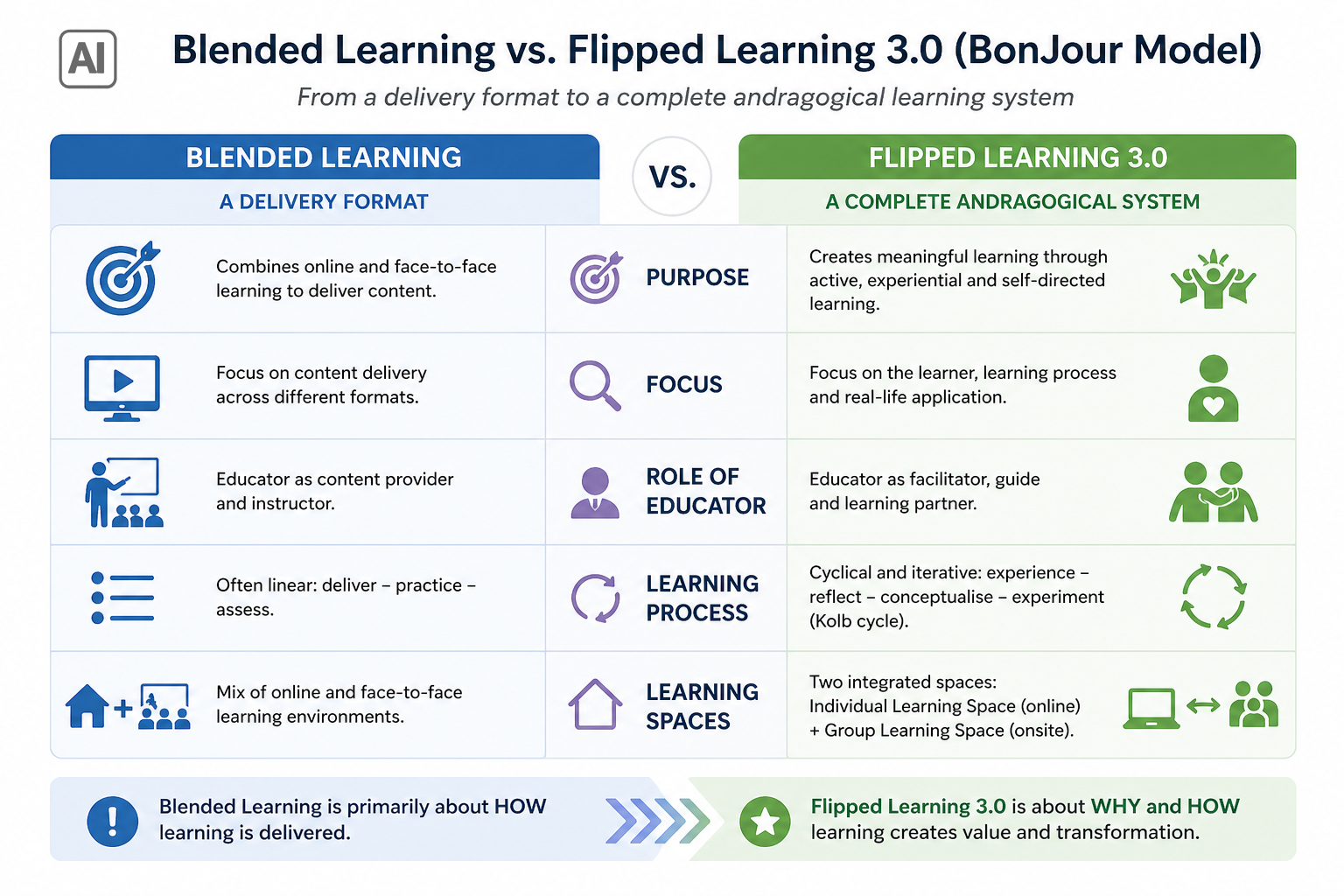
Flipped Learning 3.0 vs Blended Learning

At its core, Flipped Learning 3.0 integrates clear learning objectives, competence-based design, and active learning processes. It places the learner at the centre and supports self-directed learning, collaboration, and reflection. In addition, the framework connects digital tools, teaching methods, and assessment strategies in a coherent way. This creates a structured learning experience that supports both educators and adult learners, especially those aged 55 and over.

Merging Flipped Learning 3.0 with the Andragogical Model

The Berlin Model provides a structured approach to planning teaching and learning processes through its key elements: intentions, content, methods, media, and contextual conditions. The Flipped Learning 3.0 framework complements this structure by adding a strong learner-centred, competence-based, and digitally supported approach.
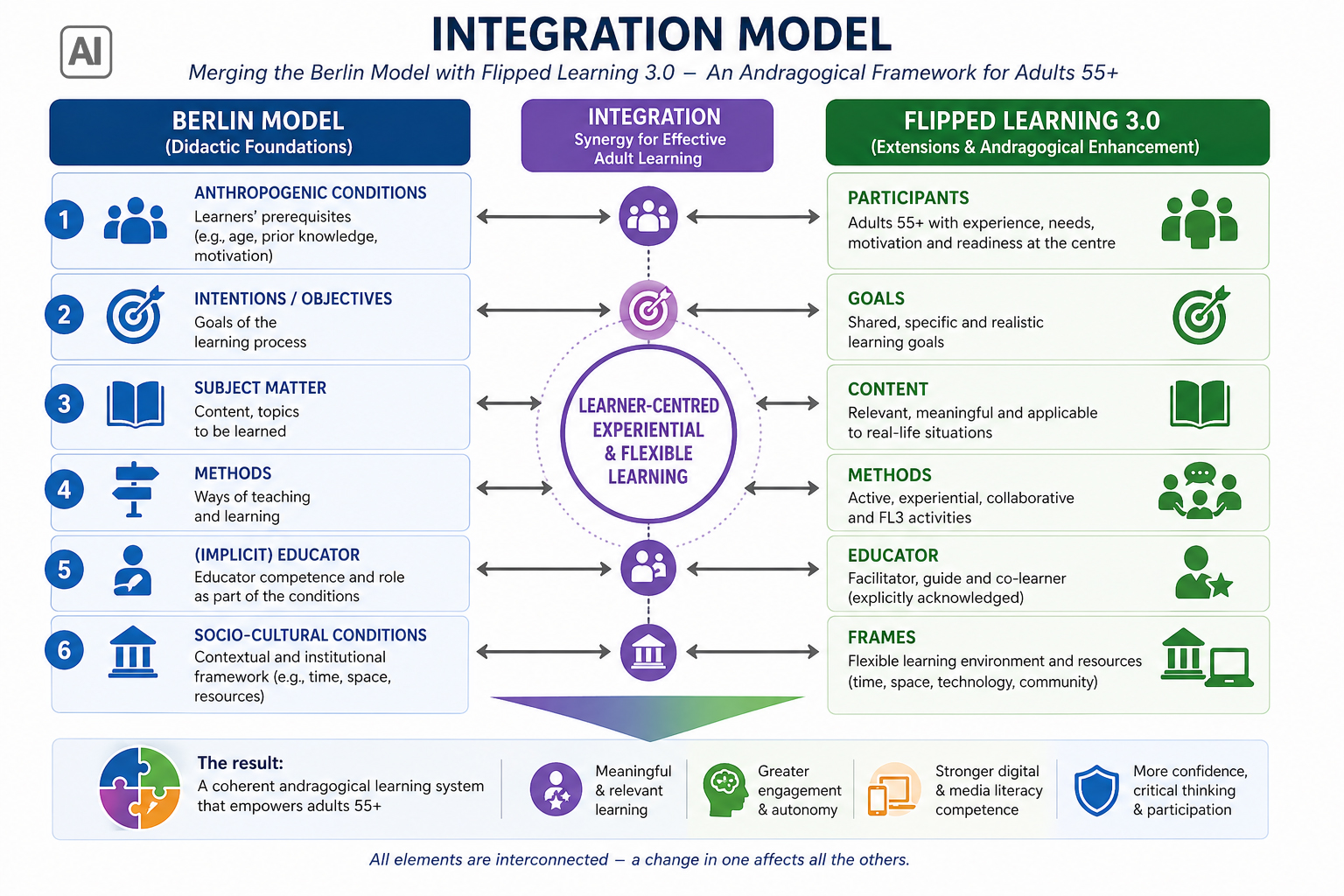
Integration of the Berlin Model and Flipped Learning 3.0
This diagram visualises the integration of the Berlin Model with the Flipped Learning 3.0 framework, combining structured didactic planning with a learner-centred, competence-based approach. Each element of the Berlin Model is enhanced by FL3 principles, creating a coherent andragogical framework for meaningful and effective adult learning. The model highlights the project’s core innovation by linking theory, pedagogy, and digital learning in a unified system.

The following section explains how both models can be effectively connected.

1. Intentions ↔ Competence-Based Learning and Learning Outcomes

In the Berlin Model, intentions define the goals of the learning process.

Flipped Learning 3.0 extends this by focusing on clearly defined, competence-based learning outcomes that describe what learners are able to do in real-life situations. This ensures that learning is practical, relevant, and aligned with adult learners’ needs. For adults aged 55+, this includes not only knowledge acquisition but also confidence, autonomy, and digital participation.

2. Content ↔ Microlearning and Structured Learning Pathways

Content in the Berlin Model refers to the selection and organisation of learning material. Flipped Learning 3.0 enhances this through microlearning units and clearly structured learning pathways. Content is broken down into small, manageable elements that are easier to understand and more accessible for adult learners. It uses the two learning spaces: Individual Learning Space (Learning Platform) and Group Learning Space (Onsite training).

This approach supports flexibility and allows learners to progress at their own pace.

3. Methods ↔ Flipped Learning and Active Learning Processes

Methods in the Berlin Model describe how teaching and learning take place.

Blended Learning 3.0 integrates the principles of Flipped Learning, where learners first engage with content individually and then apply knowledge in interactive, group-based settings. This shifts the focus from passive reception to active participation. It encourages discussion, collaboration, and problem-solving, which are essential for meaningful adult learning.

4. Media ↔ Digital Tools and Learning Platforms

Media in the Berlin Model includes all tools and materials used in the learning process.

Flipped Learning 3.0 expands this by integrating digital tools, multimedia content, and online learning platforms. These tools are not used for their own sake, but to support engagement, accessibility, and different learning preferences. For learners aged 55+, this also includes guidance and support to build digital confidence.

5. Anthropogenic Conditions ↔ Learner-Centred Design and Inclusion

The Berlin Model considers learners’ individual characteristics, such as prior knowledge, motivation, and abilities.

Flipped Learning 3.0 strengthens this by applying a learner-centred and inclusive design approach. Learning is adapted to diverse needs, including different learning speeds, digital skills, and personal backgrounds. This is particularly important for older adults, who may have very different experiences with learning and technology.

6. Socio-Cultural Conditions ↔ Flexible and Accessible Learning Environments

Socio-cultural conditions in the Berlin Model refer to the broader learning context, such as institutional settings and available resources.

Flipped Learning 3.0 responds to this by creating flexible and accessible learning environments that combine online and offline elements. This allows learning to take place in different settings and supports participation regardless of time, location, or personal circumstances.

Appendix

Here is a brief compilation of the main scientists with their contributions to a modern didactical approach. In the BonJour! Model we created the andragogical model out of their findings and publications.

Malcolm Knowles (1913–1997) was an American educator and theorist whose work fundamentally shaped the field of adult education in the English-speaking world. As a professor at Boston University and later North Carolina State University, he developed the theory of andragogy — the art and science of teaching adults — as a distinct discipline, contrasting it explicitly with the pedagogy of children. His central work, The Adult Learner: A Neglected Species (1973, revised as The Adult Learner, 1990), argued that adults are self-directed, experience-rich learners motivated primarily by internal goals, and that they learn most effectively when content is immediately relevant to their lives and needs.

David A. Kolb (born 1939) is an American educational theorist and professor emeritus at Case Western Reserve University, Cleveland. Drawing on the work of John Dewey, Jean Piaget, and Kurt Lewin, he developed the theory of experiential learning, proposing that effective learning occurs through a continuous four-phase cycle of concrete experience, reflective observation, abstract conceptualisation, and active experimentation. His foundational text, Experiential Learning: Experience as the Source of Learning and Development (1984), remains one of the most widely cited works in educational theory and has been applied extensively in adult education, management training, and professional development.

Paul Heimann (1901–1967) was a German educationalist and professor at the Free University of Berlin, where he developed what became known as the Berlin Model of didactic planning. His central contribution was the systematic analysis of teaching as a structured interplay of mutually dependent factors — goals, content, methods, media, learner prerequisites, and contextual conditions. His foundational work, co-authored with Otto and Schulz, Unterricht – Analyse und Planung (1965), remains a key reference in German-language didactics (Heimann, P., Otto, G., & Schulz, W. (1965). Unterricht – Analyse und Planung. Schroedel).

Gunter Otto (1927–1999) was a professor of art education and general didactics, closely associated with Heimann’s work at the Free University of Berlin. He contributed significantly to the theoretical refinement of the Berlin Model and to its application in aesthetic and cultural education. His collaboration with Heimann and Schulz helped establish the model as a widely used tool for teacher training and curriculum reflection in the German-speaking world.

Wolfgang Schulz (1929–1993) was a professor of education in Hamburg, who later developed the Berlin Model further into the Hamburger Modell, placing greater emphasis on learner emancipation and the social dimensions of teaching. His work bridges systematic planning and critical-reflective pedagogy, making the model more responsive to the lived realities of diverse learner groups.

The most direct theoretical bridge between the Berlin Model and the BonJour planning framework is provided by Horst Siebert (1939–2022), emeritus professor of adult education at the University of Hanover. In his widely used guide Methoden für die Bildungsarbeit (4th ed., Bielefeld: wbv, 2010), Siebert proposes that method selection in adult education must consider the institutional framework, the participants, the goals and content, and the educator — a set of criteria that maps directly onto the BonJour planning model and confirms the continued relevance of the Berlin Model’s interdependence principle for non-formal adult learning contexts.

A parallel contribution, in the adjacent field of higher education, came from Wolff-Dietrich Webler, long-serving director of the Interdisciplinary Centre for Higher Education Didactics (IZHD) at the University of Bielefeld. Working within universities rather than community education settings, Webler developed a similarly systematic approach to reflective teaching and learning design — one that informed, in a modest but tangible way, the broader thinking behind the BonJour model.
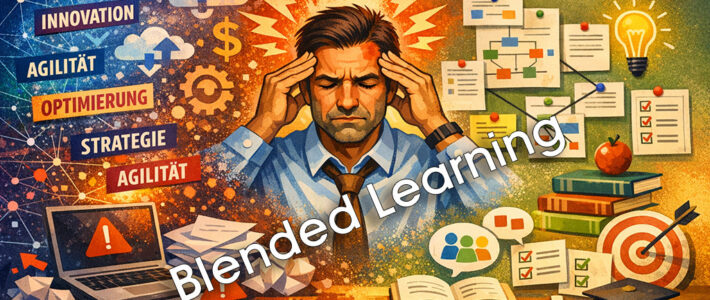
Blended Learning = Simple Delivery of Learning?

Blended Learning = Simple Delivery of Learning?

Preamble “Blend the Learning”

In 2013, I started wit a project on Quality in Blended Learning. I felt it necessary to examine the concept of Blended Learning – which is interesting in principle – from the perspective of quality: teaching must meet certain quality standards.

This led to a two-year project in which a European project group (Grundtvig Adult Education Project 539717-LLP-1-2013-1-IT-GRUNDTVIG-GMP) addressed the issue and developed solutions. One of the outcomes was a book on quality in Blended Learning. Nevertheless, a certain dissatisfaction remained, as there were no concepts in Blended Learning that were, in principle, effective.

In autumn 2018, I met Jon Bergmann, and he had the solution: the Flipped Learning 3.0 Framework, which uses Blended Learning as a concept but satisfies all outstanding requirements within the complete framework.

Ten years after the end of the ‘Quality in Blended Learning Project’ (this is the archive of the project’s web page), I venture a critical assessment of the current situation.

1 Introduction

Blended Learning has become one of the most widely used concepts in educational discourse over the past two decades. It appears in policy documents, institutional strategies, funding programmes, and conference presentations across the world. Everybody seems to be doing it. And yet, if you ask ten educators what Blended Learning actually means, you will likely get ten different answers. That is not a sign of a rich and nuanced concept. It is a warning signal.

This paper argues that Blended Learning, despite its popularity, is conceptually too vague to serve as a meaningful guide for educational design. It lacks a shared definition, a clear pedagogical foundation, and consistent design principles. As a result, it risks becoming — or perhaps already is — little more than a convenient buzzword.

2 Conceptual Ambiguity of Blended Learning

A review of the literature reveals that blended learning is defined in multiple and sometimes contradictory ways. Some authors describe it as a straightforward combination of online and face-to-face instruction. Others insist on the need for deliberate pedagogical integration. The gap between these positions is significant.

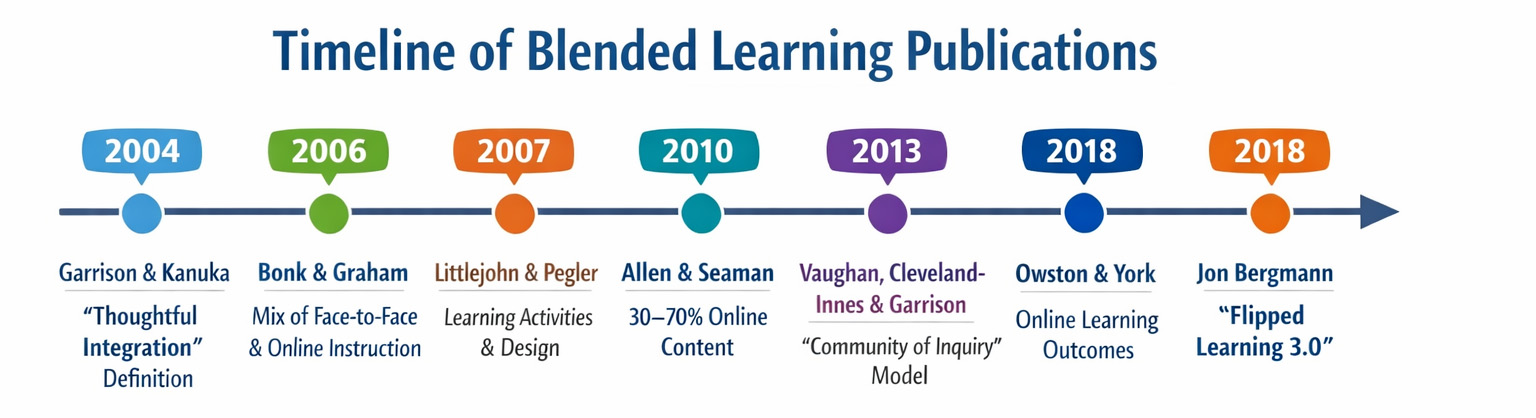
Garrison and Kanuka (2004) offered what became one of the most cited definitions: Blended Learning as “the thoughtful integration of classroom face-to-face learning experiences with online learning experiences.” The key word here is “thoughtful” — suggesting that simply putting some content online does not qualify. Bonk and Graham (2006), on the other hand, described it more structurally as the combination of face-to-face instruction with computer-mediated instruction, leaving the door open for far simpler interpretations.

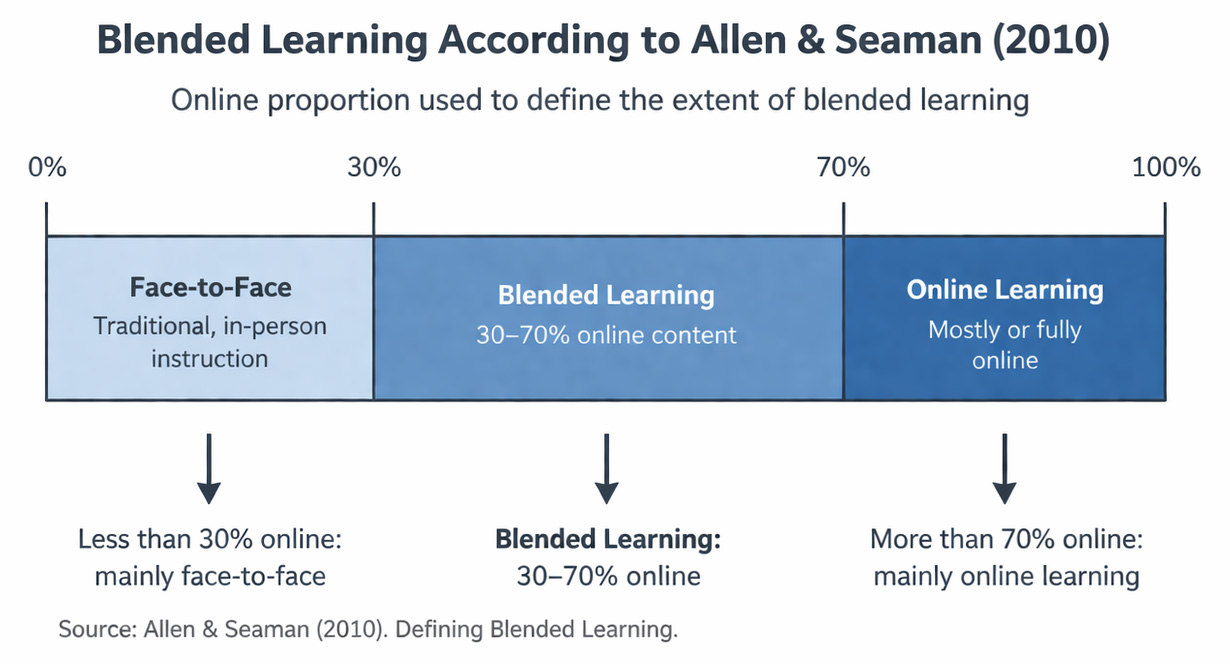
Allen and Seaman (2010) approached the concept from a purely quantitative angle, defining Blended Learning as any course where between 30 and 70 per cent of instruction takes place online. This percentage-based view reduces a complex educational question to a simple ratio. It tells us nothing about what happens during those online or face-to-face hours, or whether they connect meaningfully at all.

Percentage of the blend
Image: Blended Learning, defined as 30–70% of instruction delivered online (Allen & Seaman, 2010)

This conceptual ambiguity is not a minor academic debate. It directly limits the analytical and practical value of Blended Learning as a concept. If the same label can describe a carefully designed course built around collaborative inquiry and a course that simply uploads lecture slides to a learning management system, then the label is doing very little work.

3 Lack of Pedagogical Specificity

Blended Learning can be understood as an open and flexible concept that allows educators to combine and adapt a wide range of pedagogical approaches, offering the freedom to design learning experiences that best fit diverse contexts and learner needs.
Blended Learning does not prescribe a specific pedagogical approach, learning theory, or instructional design model. This is not a neutral feature — it is a fundamental weakness. A concept that is compatible with constructivism, instructivism, collaborative learning, and flipped classroom models simultaneously is not a framework at all. It is a container.

To be fair, some authors acknowledge this openly. Bonk and Graham (2006) note that Blended Learning can accommodate a wide range of pedagogical approaches. But acknowledging openness is not the same as providing guidance. A teacher or course designer looking for clear principles will not find them in the Blended Learning literature. What they will find is flexibility — which, on its own, is not enough.

Garrison and Kanuka (2004) rightly emphasise that Blended Learning requires the alignment of learning objectives, activities, and interaction formats. But this is simply good instructional design — not a feature unique to Blended Learning. Any well-designed course, regardless of its format, should do the same.

Timeline visualising essential development steps
Image: Essential development steps of Blended Learning

4 The “Anything Goes” Problem

Due to its broad and flexible definition, Blended Learning risks becoming an umbrella term under which almost any instructional design can be categorised. A short video clip added to a traditional lecture. A weekly online quiz alongside face-to-face seminars. A fully online course with one in-person workshop per semester. All of these can be — and have been — labelled as Blended Learning.

This “anything goes” characteristic is not just intellectually unsatisfying. It has real consequences. When everything qualifies as Blended Learning, the concept loses its capacity to distinguish between good and poor design. It becomes impossible to evaluate whether a blended approach is actually better than a purely face-to-face or purely online alternative — because “blended” no longer means anything specific enough to test.

Owston and York (2018) found that the proportion of online content mattered less than expected for learning outcomes, with the best results appearing at 33 to 50 per cent online. This is useful data. But it still does not tell us what kind of online content, in what sequence, for what purpose, and with what pedagogical rationale — the questions that actually matter for course design.

5 Blended Learning as a Buzzword

Blended Learning is often used as a positively connoted buzzword in policy and practice, functioning more as a rhetorical label than a clearly defined pedagogical concept, which leads to inconsistent implementation and risks masking a lack of real educational substance.
The widespread adoption of the term Blended Learning in policy documents, institutional strategies, and funding programmes suggests that it often functions as a rhetorical device rather than a precise academic concept. It carries broadly positive connotations — it sounds modern, flexible, and learner-centred — without committing to anything specific.

This matters. When institutions invest in Blended Learning without a clear definition of what that means in practice, the result is often inconsistent implementation. Some departments may interpret it as flipped classroom design; others as simply adding a Moodle page to an existing course. Both counts. Neither is necessarily wrong. But neither is the same thing.

There is also a risk that positive connotations obscure the absence of pedagogical substance. A course labelled as Blended Learning may receive institutional approval and funding precisely because of the label, rather than because of any clearly defined learning rationale. The term has become, in some contexts, a quality signal without quality criteria.

6 Consequences for Practice and Research

The conceptual vagueness of Blended Learning has practical consequences. In course design, it can lead to inconsistent decisions, unclear learning outcomes, and difficulty in evaluating whether a particular design is effective. If a course does not work well, is it because of the blend, the pedagogy, the content, or the context? Without a clearer framework, it is hard to know — and hard to improve.

For research, the problem is equally significant. Studies on Blended Learning are notoriously difficult to compare because they use different definitions, different measures, and different contexts. A meta-analysis of Blended Learning research is, in many ways, a meta-analysis of several quite different things. This limits the cumulative value of the evidence base.

For projects requiring clear and comparable design criteria — such as Erasmus+ partnerships working across institutions and national contexts — this vagueness is particularly problematic. Shared implementation becomes difficult when the core concept means different things to different partners.

7 Towards a More Precise Alternative

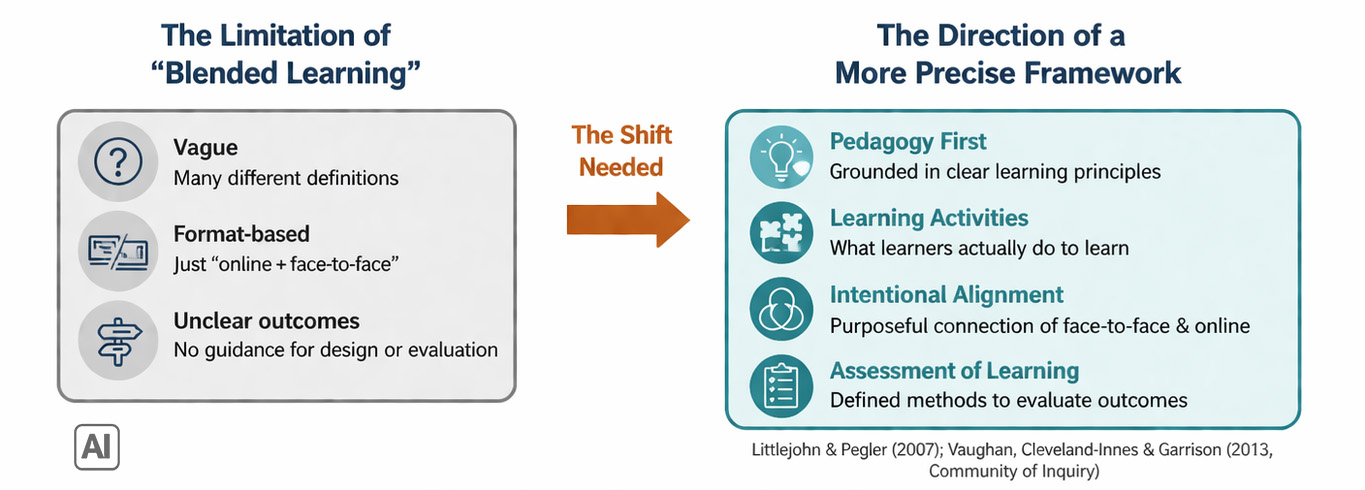
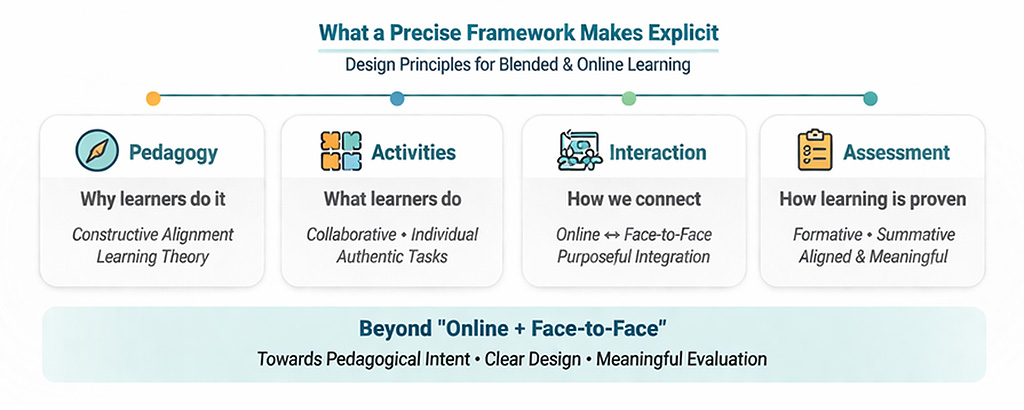
To move beyond the limitations of Blended Learning as a broad and ambiguous concept, more precise design frameworks are needed. These frameworks should explicitly define the pedagogical principles that guide course design, the types of learning activities included, the role of face-to-face and online components, and the methods used to assess learning.

Littlejohn and Pegler (2007) point in a useful direction, emphasising the importance of learning activities and didactic design rather than the format itself. Vaughan, Cleveland-Innes, and Garrison (2013) offer the Community of Inquiry model as one possible framework, grounding blended design in principles of cognitive, social, and teaching presence.

Needs to develop Blended Learning to a framework
Image: Needs to develop Blended Learning to a framework

What these approaches share is a shift away from describing the format — online plus face-to-face — towards describing the pedagogical intent. That is the right direction. A framework worth the name should be specific enough to guide decisions, distinguish between good and poor design, and support meaningful evaluation. Blended Learning, as currently defined, does not reliably do any of these things.

8 Lessons Learned & Conclusion

Blended Learning has played a genuinely useful role in opening the conversation about how digital and face-to-face education can work together. That conversation was worth having, and it has produced some valuable insights. But a useful starting point is not the same as a reliable framework.

The core problem is straightforward: Blended Learning is too broad to guide educational design with any precision. It accommodates too many approaches, prescribes too little, and has become too closely tied to institutional branding and policy rhetoric. The term tells us what format a course uses — some online, some face-to-face — but says almost nothing about how or why.

Visualisation of a Blended Learning Concept
Image: Visualisation of a Blended Learning Concept

If we are serious about improving the quality of learning — in higher education, in professional training, or in any other context — we need frameworks that are more precise, more pedagogically grounded, and more honest about what they require. The Blended Learning, as a framework, is a useful further development and a promising approach to modern, technology-supported teaching and training. Nevertheless, it will be that what Flipped Learning 3.0 is today.

9 Appendix: Learning Methods

  • Constructivism: This is the idea that we learn by doing. You build your own knowledge through experience and by solving problems.
  • Instructivism (Lecture-style teaching): This is a more traditional way of learning. A teacher gives you information directly, and you listen to understand the facts.
  • Collaborative Learning: This means learning together in a group. You talk to other people to share ideas and help each other understand a topic.
  • Flipped Classroom: In this model, you study new material at home first. Then, you use your time in class to do practical work and ask the teacher questions.

10   References

Allen, I. E., & Seaman, J. (2010). Class differences: Online education in the United States, 2010. Babson Survey Research Group / The Sloan Consortium.
Bonk, C. J., & Graham, C. R. (2006). The handbook of blended learning: Global perspectives, local designs. Pfeiffer.
Garrison, D. R., & Kanuka, H. (2004). Blended learning: Uncovering its transformative potential in higher education. Internet and Higher Education, 7(2), 95–105.
Littlejohn, A., & Pegler, C. (2007). Preparing for blended e-learning. Routledge.
Owston, R., & York, D. N. (2018). The nagging question when designing blended courses: Does the proportion of time devoted to online activities matter? Internet and Higher Education, 36, 22–32.
Vaughan, N. D., Cleveland-Innes, M., & Garrison, D. R. (2013). Teaching in blended learning environments: Creating and sustaining communities of inquiry. Athabasca University Press.

This article was developed in the frame of the “BonJour! Media Literacy Project”. The author P. Mazohl was the responsible Austrian Project Manager and responsible for the “BonJour! Learning Platform”. This platform represents the web-based learning content in the sense of Blended Learning. Nevertheless, the implementation of the platform followed the Flipped Learning 3.0 Framework (which includes Blended Learning as one of its elements).

Funded by the European Union. Views and opinions expressed are however those of the author(s) only and do not necessarily reflect those of the European Union or the European Education and Culture Executive Agency (EACEA). Neither the European Union nor EACEA can be held responsible for them.

Media Literacy for 55+: BonJour! Project Presented at St. Bernhard (Wiener Neustadt)

Media Literacy for 55+: BonJour! Project Presented at St. Bernhard (Wiener Neustadt)

BonJour LogoUnderstanding, questioning and correctly interpreting media was the central theme of a recent evening event held at the Bildungszentrum St. Bernhard in Wiener Neustadt. The event was organised by Peter Mazohl and focused on the EU co-funded BonJour! project (Erasmus+ 2023-1-IT02-KA220-ADU-000160320, focusing on media literacy), which aims to strengthen media literacy among adults aged 55 and over.

The BonJour! project offers a web-based learning platform designed to help older adults develop important digital and media skills. Participants can learn how to create digital content and gain a more profound understanding of how images, news, and social media shape our perception. A particular focus is placed on recognising reliable information, identifying fake news, and critically evaluating media content.

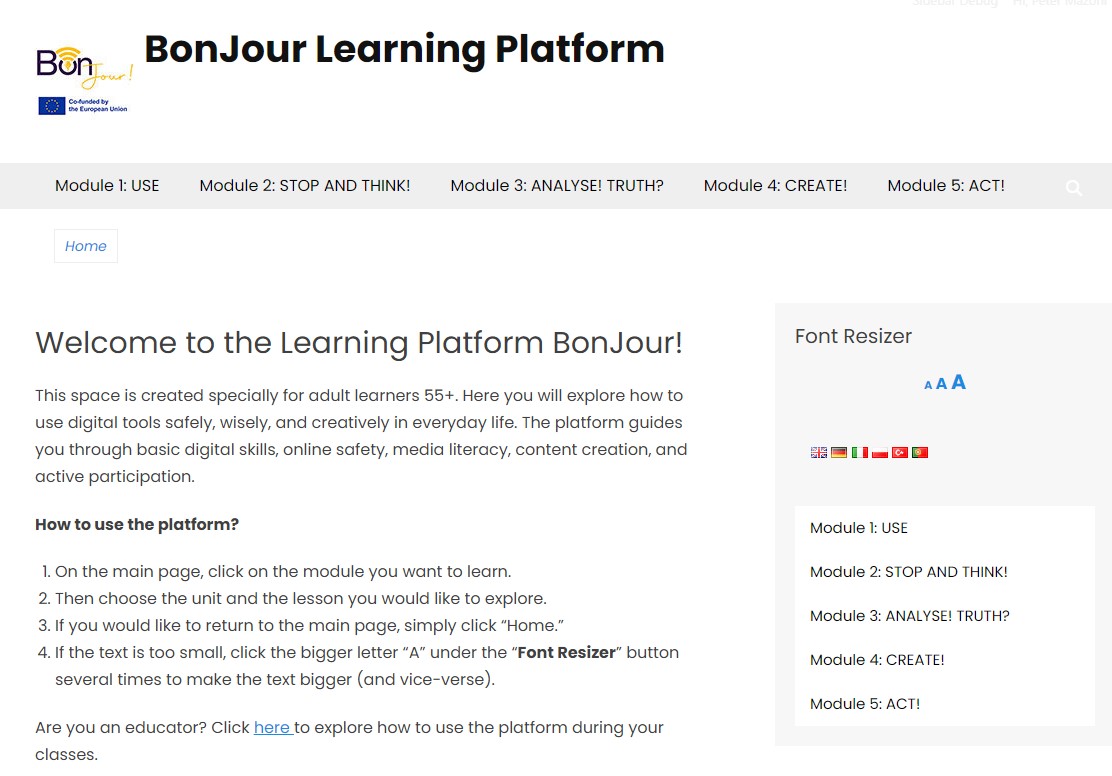
Screenshot Platform
Screenshot of the opening page of the learning platform.

During the event, several speakers provided short impulse presentations from different professional perspectives. Peter Mazohl, the Austrian project coordinator, introduced the BonJour! project and highlighted the importance of media literacy in an increasingly digital society.

Philipp Grabner, formerly a local journalist and now a member of the editorial team of the Niederösterreichische Nachrichten, spoke about the importance of local journalism and the challenges faced by today’s media landscape. His presentation addressed how misinformation and filter bubbles can influence public opinion.

Michael Mazohl, media consultant, podcaster and author, explored the dynamics of social media under the title “Links, Likes and Lies”. His talk focused on how online platforms influence communication, visibility and the spread of information.

Finally, media educator Harald Makl presented the structure of the BonJour! learning platform. The platform consists of five modules and offers personalised learning paths, automated progress analysis and feedback. It is designed to be easy to use and to support learners in developing media competence independently.

Penalists
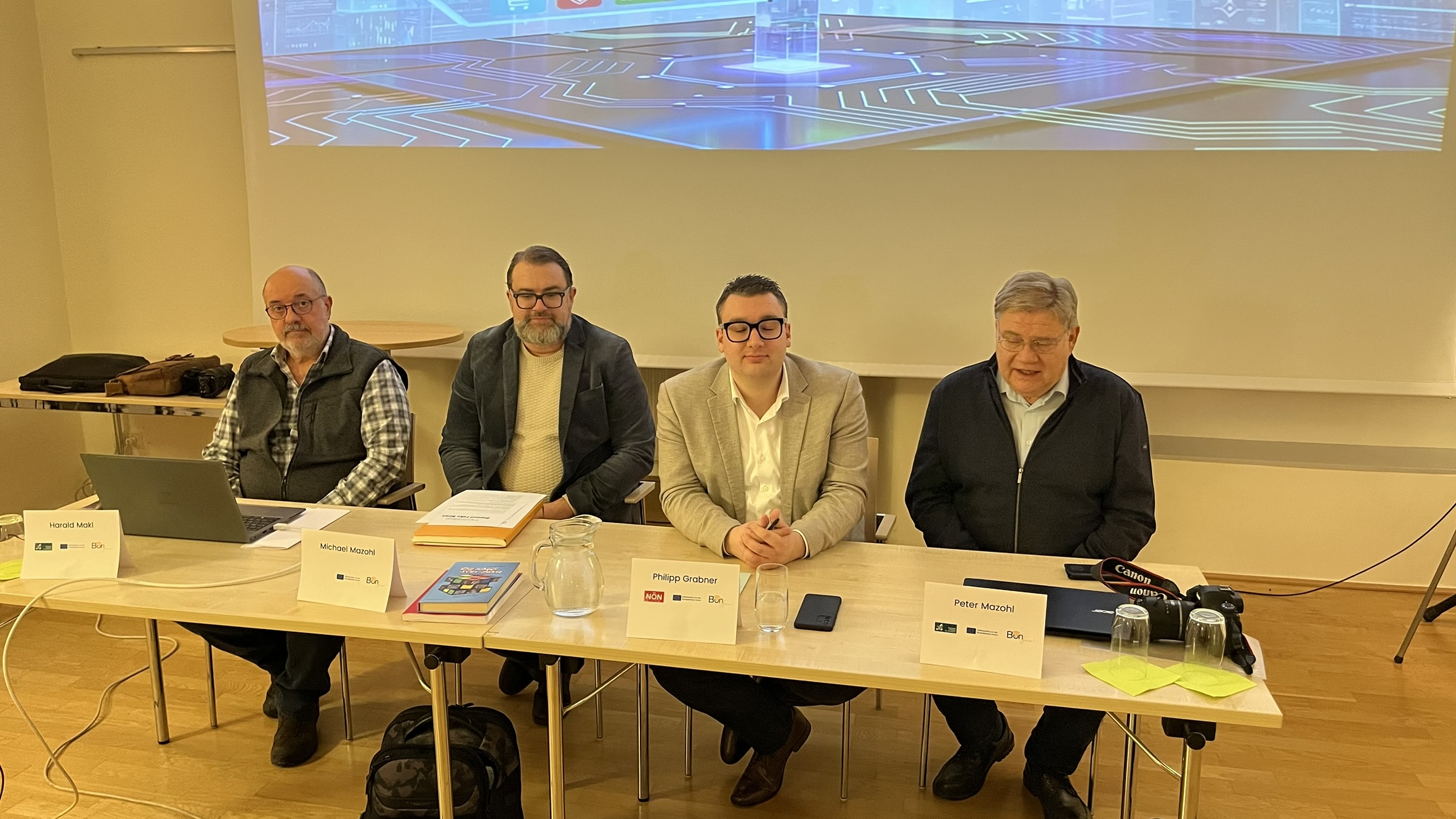
The panellists of the event (from left to right): Harald Makl (Media Educator), Michael Mazohl (Blogger, Author and media consultant), Philipp Grabner (Journalist) and Peter Mazohl (Head of the EBI)

Open for questions

The evening concluded with a panel discussion and open Q&A session, giving participants the opportunity to ask questions and share their perspectives. The event ended in a relaxed atmosphere with a small buffet, allowing for further conversations and exchange of ideas.

The strong interest from participants showed that media literacy is an increasingly important topic—especially for older adults who want to navigate the digital world confidently and responsibly.

Participants
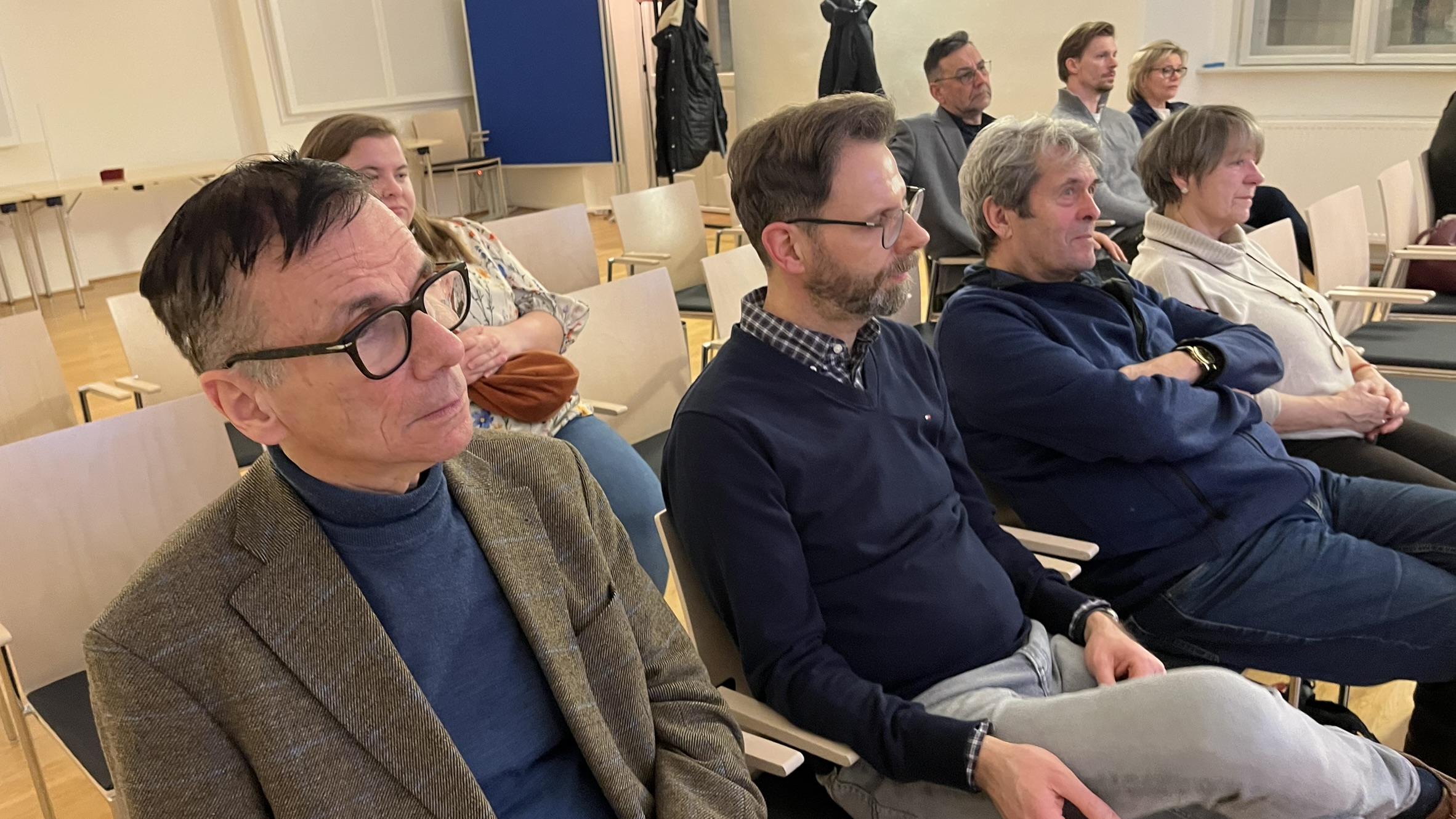
The audience was first listening the introduction, but started timely an interesting discussion with the panellists.
Funded by the European Union. Views and opinions expressed are however those of the author(s) only and do not necessarily reflect those of the European Union or the European Education and Culture Executive Agency (EACEA). Neither the European Union nor EACEA can be held responsible for them.

How Easy Is It to Use? What the BonJour! Platform Evaluation Revealed

How Easy Is It to Use? What the BonJour! Platform Evaluation Revealed

When a digital learning platform is designed for adults aged 55 and over, usability is not just a technical concern — it is central to whether the platform works at all. If people find a system confusing, frustrating, or difficult to navigate, they are unlikely to engage with it, regardless of how strong the content may be. This is why the BonJour! Project team chose to evaluate the platform using one of the most established methods in the field: the System Usability Scale, or SUS.

What is the System Usability Scale?

The SUS is a standardised questionnaire that has been used in usability research for decades. It consists of ten short statements about a system — covering aspects such as ease of use, consistency, learnability, and user confidence. Participants respond on a five-point scale, ranging from “strongly disagree” to “strongly agree”. The responses are then converted into a single score between 0 and 100.

Scores above 68 are considered above average. Scores above 80 indicate very good usability, and scores approaching or exceeding 90 are regarded as excellent — placing a system in the top tier of comparable digital tools.

How the evaluation was carried out

A total of 30 participants took part in the evaluation across five modules of the BonJour! platform. The questionnaire was administered in German, maintaining the language of the training programme. After completing each module, participants answered the ten SUS questions, allowing the team to assess usability not just for the platform as a whole, but for each module individually.

What the results show

The results are encouraging across the board. The overall mean SUS score for the platform was 84.8 out of 100, placing it firmly in the “very good” range and close to the threshold that benchmarks describe as excellent.

SUS Graphic - Position of the Bonjour Platform

Looking at the individual modules, a clear pattern emerges. Module 1 — the entry point to the course — achieved a score of 76.3. While this is still a good result, it is the lowest of the five modules. This is not surprising: first encounters with a new platform often require more orientation, and users naturally need some time to familiarise themselves with the structure and navigation. The scores then rise consistently, with Module 2 reaching 83.3, Module 5 84.2, and Module 4 an impressive 89.6.

The standout result belongs to Module 3 — Analyse! Truth? — which achieved a mean SUS score of 91.9. This places it in the “excellent” category and suggests that the module’s design, structure, and interaction flow were particularly well received. It represents a best-practice example within the course and offers useful insights for further development of other modules.

Evaluation of the various modules
The graphic compared the various modules, in context with the mean value over all modules.

What participants said, in numbers

At the level of individual questionnaire items, participants rated the platform particularly highly for ease of use, the quality of integrated functions, and how quickly they were able to learn to use the system. User confidence while navigating the platform was also notably high. Minor variation appeared in responses related to the need for technical support and the perception of consistency — areas that are worth monitoring in future iterations, though they do not indicate any systematic problem.

What this means in practice

A SUS score of 84.8 is a strong result for any digital platform. For a learning tool aimed specifically at adults who may have varying levels of digital experience, it is particularly meaningful. It suggests that the BonJour! platform is accessible, intuitive, and well-structured — and that most users can engage with it without significant barriers.

Usability of this standard supports not only a positive user experience, but also the educational goals of the project. When a platform is easy to use, learners can focus on what matters: the content, the activities, and the skills they are developing. The BonJour! evaluation results suggest the platform is delivering on that promise.

Further reading: SUS explained simply

The System Usability Scale (SUS) is a short, standardised questionnaire used to measure how easy a system is to use. It consists of ten statements — five positive and five negative — which users rate on a scale from 1 (strongly disagree) to 5 (strongly agree).

The responses are converted into a single score between 0 and 100. This score reflects the overall usability of a system as perceived by its users. It does not measure technical performance, but captures how confident, comfortable, and in control users feel when interacting with the system.

Scores are interpreted against established benchmarks:

  • Below 68 — below average; improvements are needed
  • 68–79 — good; the system performs adequately
  • 80–89 — very good; users find the system largely intuitive
  • 90–100 — excellent; the system is considered best-in-class

SUS is widely used in usability research because it is quick to complete, easy to analyse, and produces reliable results even with small groups of participants. It can be applied to any system — digital or physical — and is particularly useful for comparing usability across different versions or modules of a product.


Likes, lies, editorials: how we maintain our bearings in the digital transformation (EN)

In a time when news no longer lies printed on the breakfast table but appears on our smartphones every second, the nature of information has changed fundamentally. In the past, editorials in well-known newspapers formed the basis of public debate; today they compete with short-lived “likes” and often questionable messages on social networks. This clearly calls for “media literacy for seniors” and for all citizens who want to engage with media in a critical way.

For many citizens, especially for the generation that grew up with the reliability of traditional journalism, an urgent question arises: Who can we still trust in this digital labyrinth?

Photo by cottonbro studio (Pexels)

The narrow line between opinion and manipulation

Digital change offers great opportunities for participation, but it also brings risks for social cohesion. Disinformation and targeted false messages can polarise debates and weaken trust in our democratic institutions. The generation 55+ in particular faces a new challenge here: to combine their many years of life experience with the technical mechanisms of the digital world.

Where does the personal opinion of a user end, and where does a systematic lie begin? To recognise this narrow line, more than technical knowledge is needed – it requires a return to the principles of professional journalism.

Photo by ready-made by Pexels

A look into the workshop of truth

This is exactly where our upcoming event begins. We are pleased to welcome two experts who will help bring clarity to the dense flow of information:

  • A leading journalist will speak about the struggle for objectivity in the digital age and explain why well-researched editorials are still an essential compass today.

  • An experienced media consultant, author and blogger will provide insights into the careful practice of research. Using his current book, which is based on more than 200 verified sources, he will show that truth is not a coincidence, but the result of hard and systematic work.

The BonJour! Project: building bridges and strengthening skills

BonJour LogoBehind these activities stands the BonJour Project. Our goal is to strengthen the media literacy of older adults in a sustainable way. We believe that media education is not a privilege of the young, but a necessary condition for active citizenship at every age.

We developed the new professional role of the “Media Educator for the Elderly” – specialists who support seniors in becoming not only consumers, but confident and critical actors in the digital world. The aim is to strengthen critical thinking, increase self-confidence, and build bridges between generations.

These efforts are supported by an online course that offers an overview in five modules. It introduces basic knowledge about working on the internet, understanding the difference between facts and opinions, and creating reliable journalistic publications. The self-learning course is available on an easy-to-access platform: BonJour! Training Kurs and is offered in German, English, Italian, Portuguese, Polish, and Turkish.

Invitation to dialogue

We warmly invite you to become part of this important debate. Let us learn together how to recognise the mechanisms of manipulation and bring the quality of information back to the centre of public discussion.

Stay informed, stay critical – together let us preserve the culture of well-founded words.

Media literacy for seniors

“In the end, media literacy for seniors is the central heart of our work in the Erasmus+ BonJour! project, because it acts as a digital shield against disinformation and gives the generation 55+ the confidence they need to take part in social dialogue safely, critically, and independently in the digital age.”Peter Mazohl

Funded by the European Union. Views and opinions expressed are however those of the author(s) only and do not necessarily reflect those of the European Union or the European Education and Culture Executive Agency (EACEA). Neither the European Union nor EACEA can be held responsible for them.

Likes, Lügen, Leitartikel: Wie wir im digitalen Wandel unsere Orientierung bewahren (DE)

In einer Zeit, in der Nachrichten nicht mehr nur gedruckt auf dem Frühstückstisch liegen, sondern im Sekundentakt auf unseren Smartphones aufpoppen, hat sich das Wesen der Information grundlegend verändert. Früher bildeten Leitartikel namhafter Zeitungen das Fundament der öffentlichen Debatte; heute konkurrieren sie mit flüchtigen „Likes“ und oft zweifelhaften Meldungen in den sozialen Netzwerken. Das schreit nach “Medienkompetenz für Senioren” und alle Bürger, die sich kritisch mit Medien auseinandersetzen wollen.

Für viele Bürger, insbesondere für die Generation, die mit der Verlässlichkeit des klassischen Journalismus aufgewachsen ist, stellt sich eine drängende Frage: Wem können wir in diesem digitalen Labyrinth noch glauben?

Photo by cottonbro studio (Pexels)

Der schmale Grat zwischen Meinung und Manipulation

Der digitale Wandel bietet enorme Chancen für die Teilhabe, doch er birgt auch Risiken für den gesellschaftlichen Zusammenhalt. Desinformation und gezielte Falschmeldungen polarisieren Debatten und gefährden das Vertrauen in unsere demokratischen Institutionen. Besonders die Generation 55+ steht hier vor einer neuen Herausforderung: Es gilt, die jahrzehntelange Lebenserfahrung mit den technischen Mechanismen der digitalen Welt zu verknüpfen.

Wo endet die persönliche Meinung eines Nutzers, und wo beginnt die systematische Lüge? Um diesen schmalen Grat zu erkennen, bedarf es mehr als nur technisches Verständnis – es bedarf einer Rückbesinnung auf das journalistische Handwerk.

Photo by ready-made by Pexels

Ein Blick in die Werkstatt der Wahrheit

Genau hier setzt unsere kommende Veranstaltung an. Wir freuen uns, zwei Experten begrüßen zu dürfen, die Licht in das Dickicht der Informationsflut bringen:

  • Ein führender Journalist wird über das Ringen um Objektivität im digitalen Zeitalter berichten und aufzeigen, warum fundierte Leitartikel gerade heute als Kompass unverzichtbar sind.

  • Ein erfahrener Medienberater, Autor und Blogger gewährt Einblicke in die akribische Praxis der Recherche. Am Beispiel seines aktuellen Buches, das auf über 200 verifizierten Quellen basiert, demonstriert er, dass Wahrheit kein Zufallsprodukt ist, sondern das Ergebnis harter, methodischer Arbeit.

Das BonJour!-Projekt: Brücken bauen, Kompetenz stärken

BonJour LogoHinter diesen Bemühungen steht das BonJour-Projekt. Unser Ziel ist es, die Medienkompetenz älterer Erwachsener nachhaltig zu stärken. Wir sind überzeugt: Medienbildung ist kein Privileg der Jugend, sondern eine notwendige Voraussetzung für aktive Bürgerschaft in jedem Alter.

Wir entwickelten das neue Berufsbild des „Media Educator for the Elderly“ – Spezialisten, die Senioren dabei unterstützen, nicht nur Konsumenten, sondern souveräne und kritische Akteure in der digitalen Welt zu sein. Es geht darum, das kritische Denken zu schärfen, die Selbstwirksamkeit zu fördern und die Kluft zwischen den Generationen zu überbrücken.

Unterstützt werden diese Bemühungen durch einen Onlinekurs, der in fünf Modulen einen Überblick über Basiswissen zum Arbeiten im Internet, dem Problem der Unterscheidung von Fakten und Meinungen und eigenen journalistisch seriösen Veröffentlichungen anbietet. Der Selbstlernkurs ist auf einer niedrigschwelligen Plattform zu erreichen: BonJour! Training Kurs und steht in den Sprachen Deutsch, Englisch, Italienisch, Portugiesisch, Polnisch und Türkisch zur Verfügung.

Einladung zum Dialog

Wir laden Sie herzlich ein, Teil dieser wichtigen Debatte zu werden. Lassen Sie uns gemeinsam lernen, wie wir die Mechanismen der Manipulation durchschauen und die Qualität der Information wieder in den Mittelpunkt rücken.

Bleiben Sie informiert, bleiben Sie kritisch – bewahren wir gemeinsam die Kultur des fundierten Wortes.

Medienkompetenz für Senioren

„Letztlich ist Medienkompetenz für Senioren das entscheidende Herzstück unserer Arbeit im Erasmus+ BonJour! Projekt, da sie als digitaler Schutzschild gegen Desinformation fungiert und der Generation 55+ die nötige Souveränität verleiht, um auch im digitalen Zeitalter sicher, kritisch und selbstbestimmt am gesellschaftlichen Dialog teilzunehmen.“Peter Mazohl

Funded by the European Union. Views and opinions expressed are however those of the author(s) only and do not necessarily reflect those of the European Union or the European Education and Culture Executive Agency (EACEA). Neither the European Union nor EACEA can be held responsible for them.

BonJour! Project Meeting in Funchal

BonJour! Project Meeting in Funchal

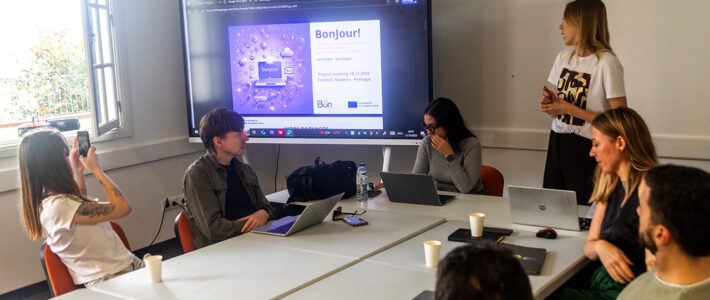
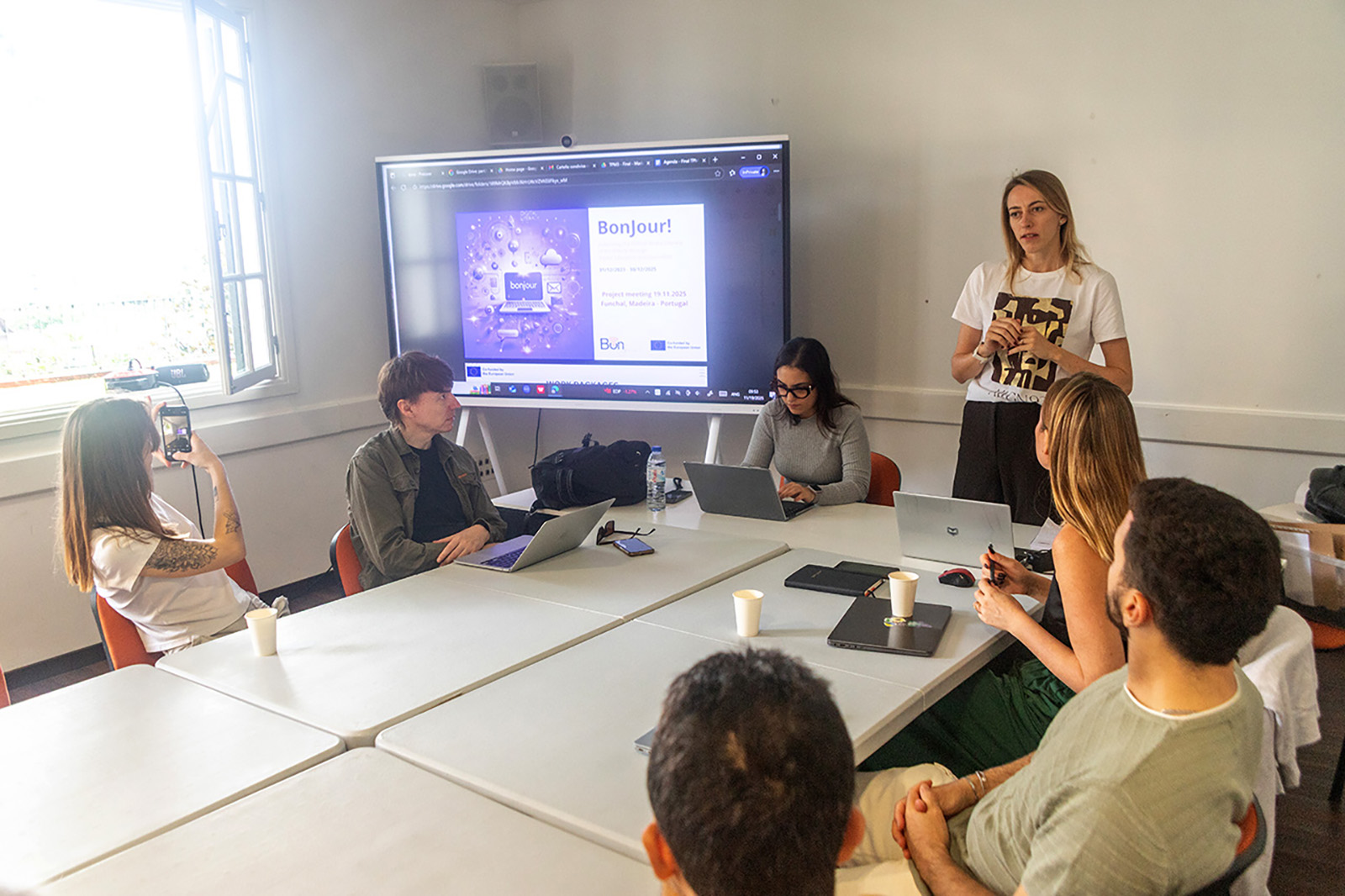
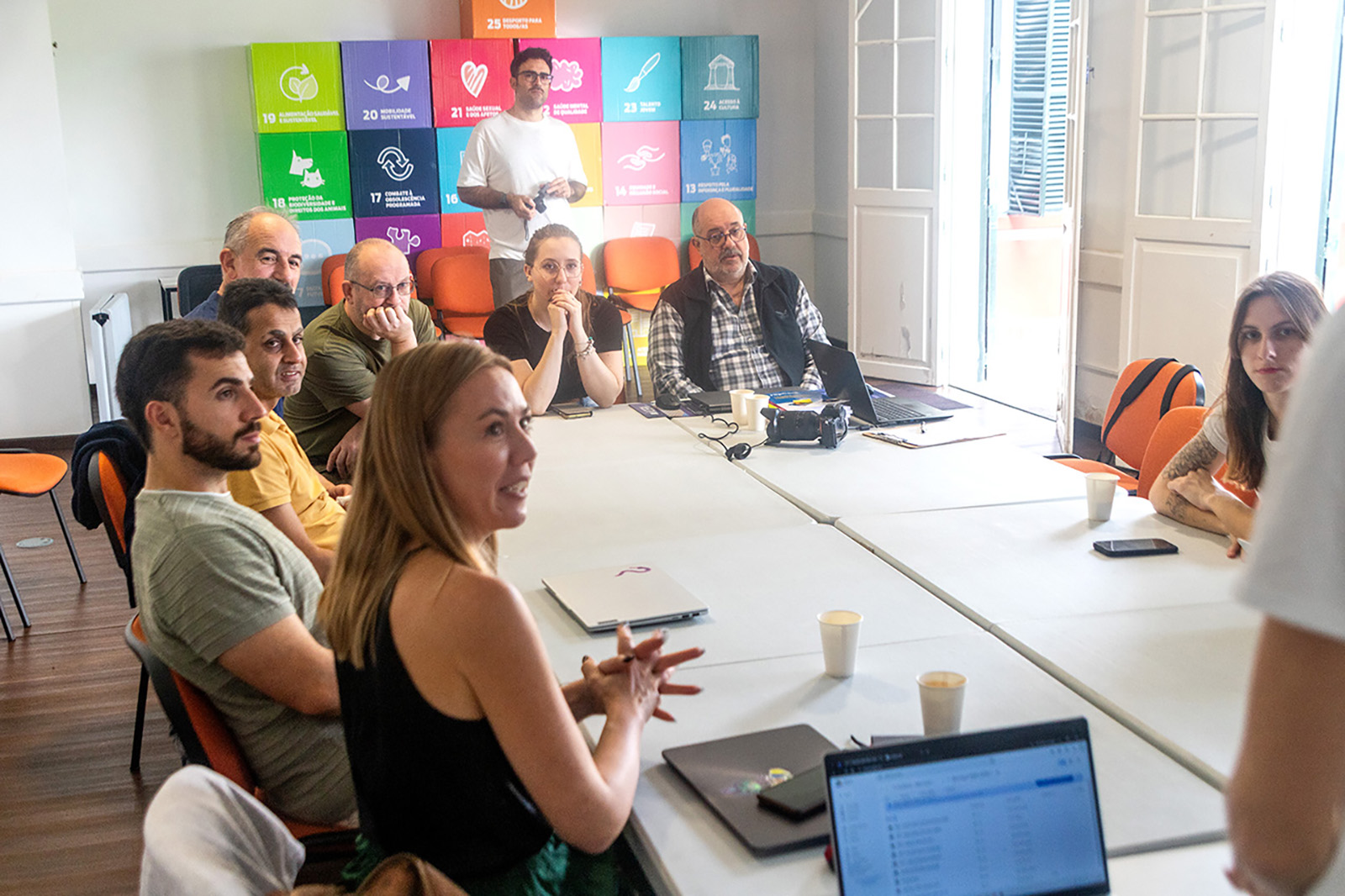
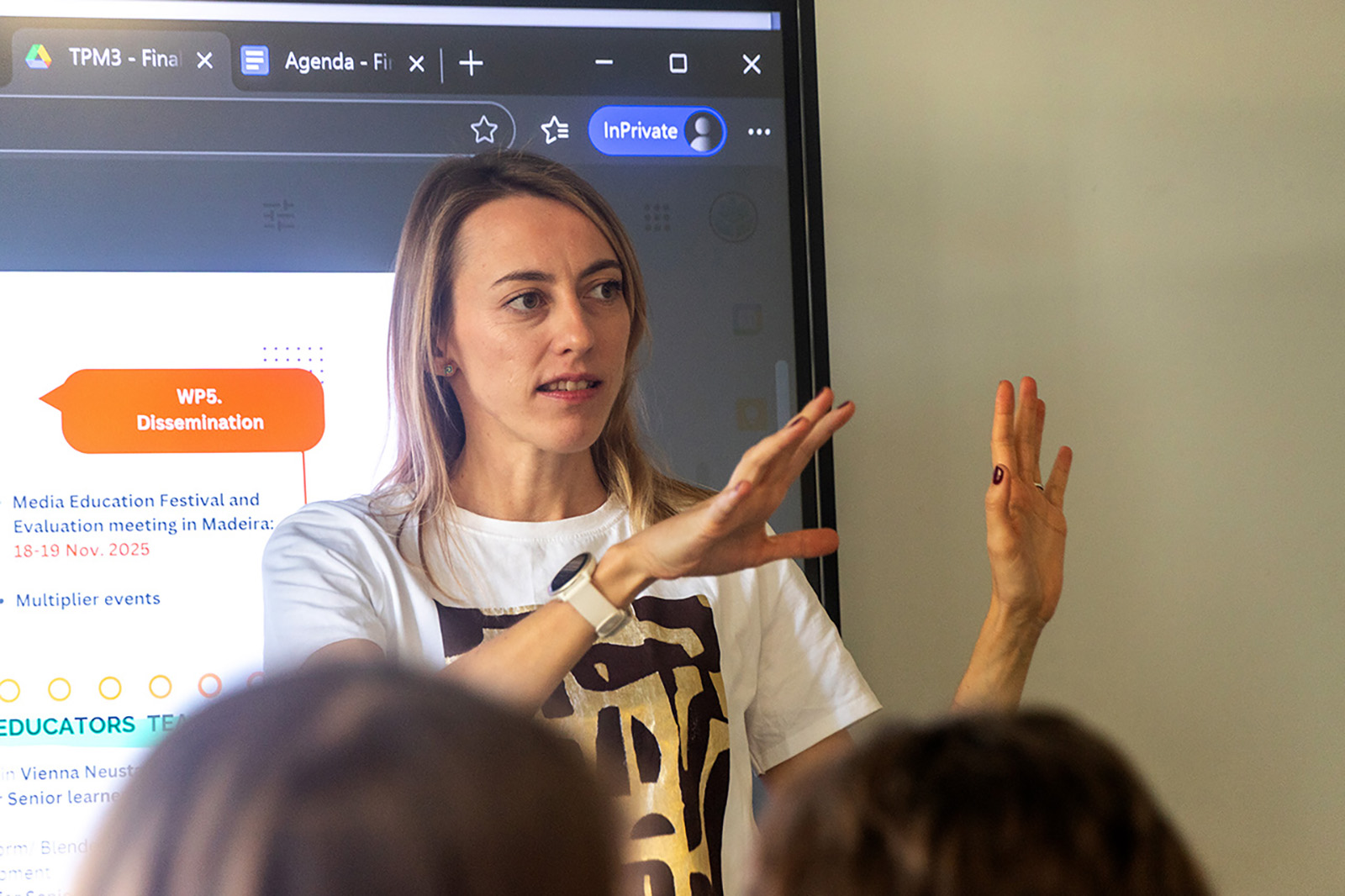
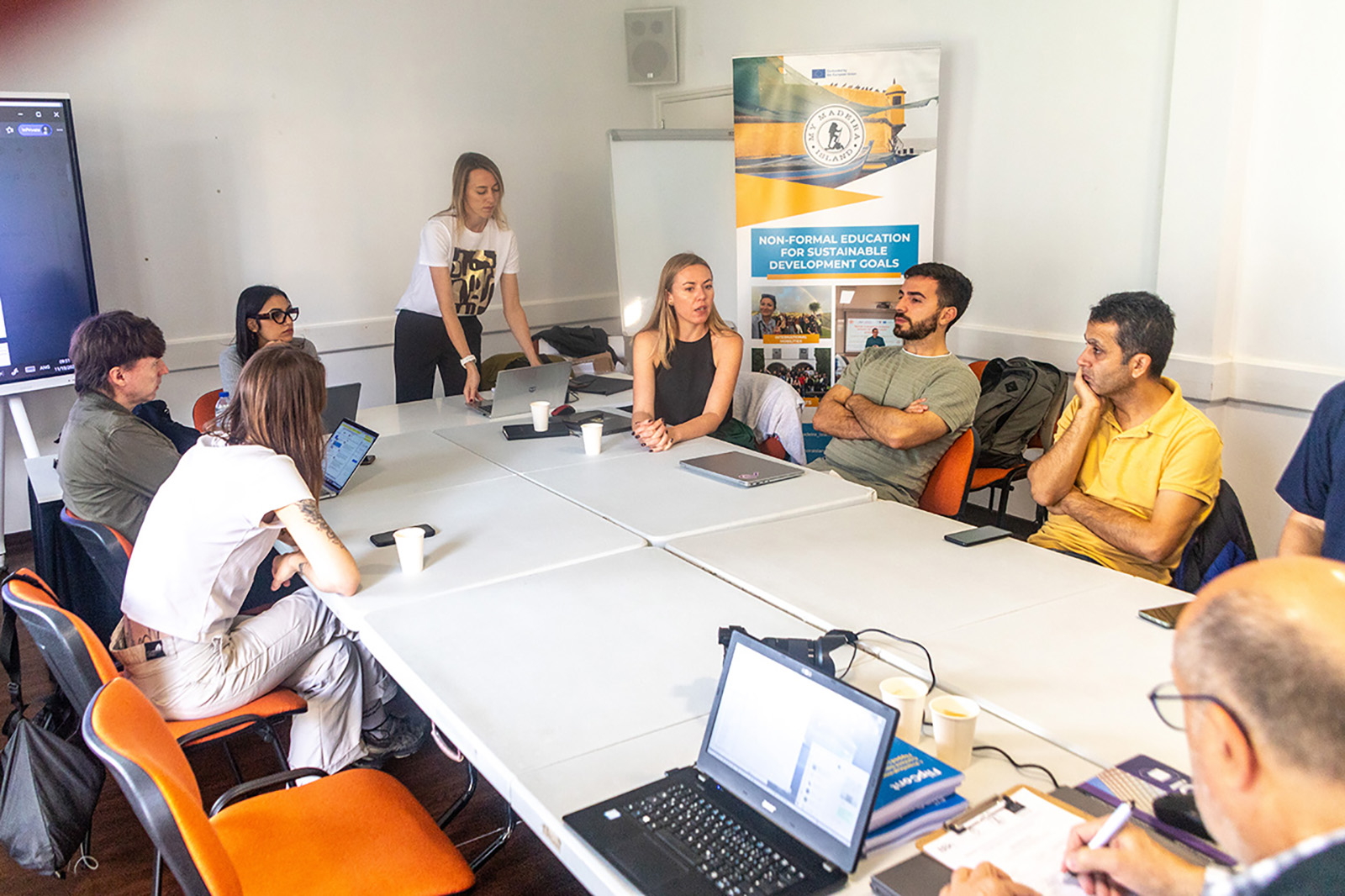
On 19 November 2025, partners of the BonJour! project met in Funchal, Madeira (Portugal) for a project coordination meeting. The meeting focused on reviewing project progress, coordinating upcoming activities, and preparing the next implementation steps.

The session began with a short overview of the overall project status, including administrative and financial updates as well as upcoming deadlines and deliverables. This helped ensure that all partners share a clear understanding of the current stage of the project.

Finalising the documentation

A central topic of the meeting was the progress of Work Packages 2 and 3, including the confirmation of remaining tasks and the planning of translations. Partners discussed responsibilities and agreed on a timeline to finalise the remaining work.

Another important part of the meeting focused on Work Package 4, particularly the development of guidelines for educators who will use the BonJour! learning platform. The partners reviewed a draft version of the guidelines and discussed how the platform can best support learning activities with senior learners.

Pilot Training of all partners

The consortium also exchanged experiences from earlier activities and began planning local training sessions for older adults in the partner countries. These sessions will help test and refine the learning platform in real learning environments.

In addition, the partners discussed the evaluation of training activities, including the design of questionnaires and the overall evaluation methodology. This will help measure the learning outcomes and improve future training activities.

6 Language Versions of the Platform

The meeting concluded with a discussion about the translation of the platform and the coordination of next steps. Partners summarised the key decisions and confirmed the upcoming milestones and deadlines.

Link to the training platform: BonJour! Training

Screenshot Platform
Screenshot of the opening page of the learning platform.

Overall, the meeting was productive and helped move the BonJour! project forward, ensuring that the learning platform and training activities continue to develop successfully.

Flipped Learning 3.0 & Icebreakers

Flipped Learning 3.0 & Icebreakers

When I talk about Flipped Learning, people often expect discussions about videos, self-paced content, or digital tools. But very quickly, the conversation shifts somewhere else. It shifts to what actually happens when learners come together.

Because in Flipped Learning 3.0, the group space is where the real work begins. It is where ideas are exchanged, questions are explored, and understanding is built together. And that makes one thing surprisingly important: how we start.

That is why I find myself coming back to icebreakers.

Not because they are central to the method, but because they reveal something deeper. They show how we think about learning, about participants, and about the purpose of our time together.

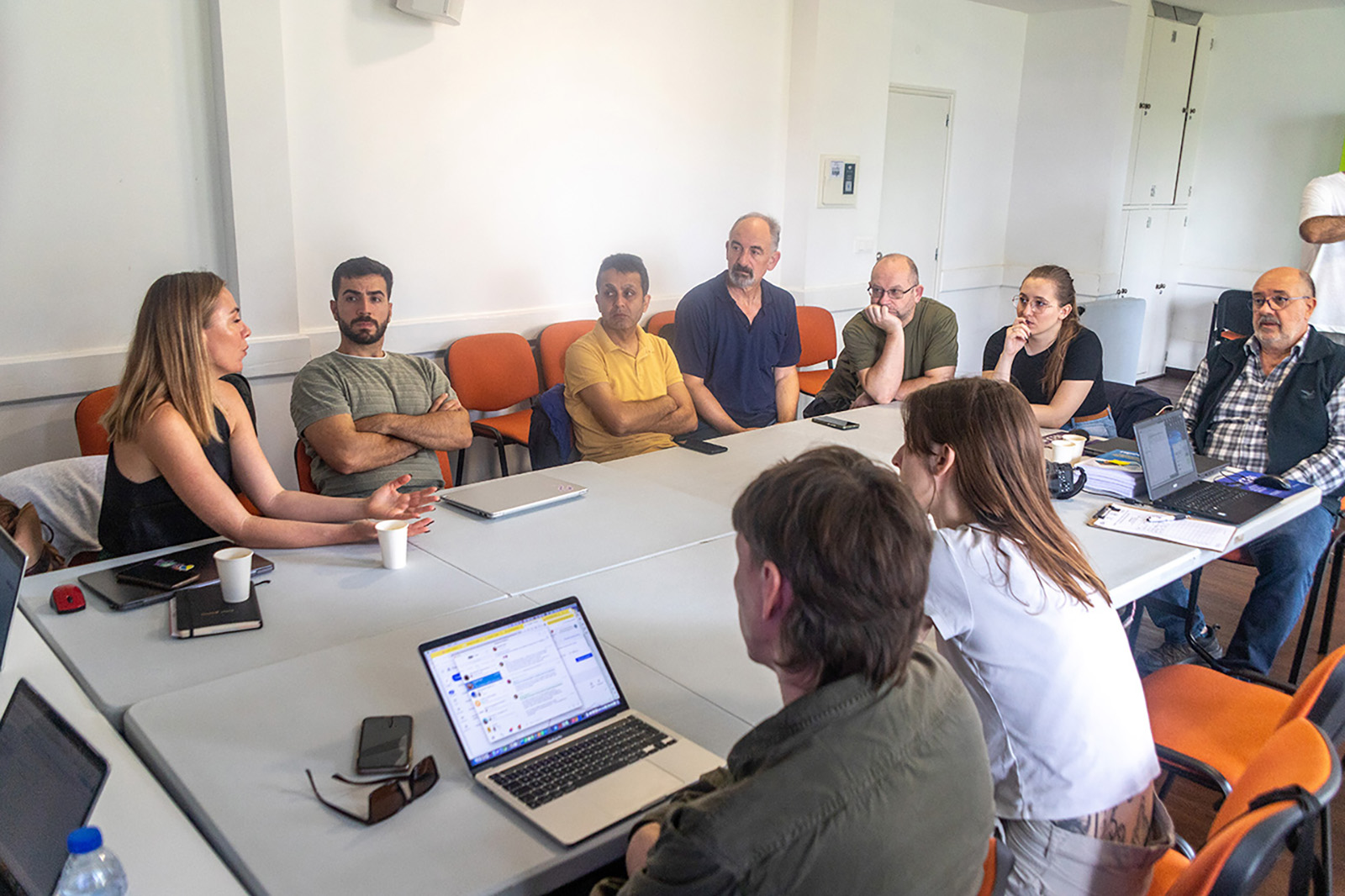
Picture of people during an icebreaker activity.
Not everyone in the room is equally convinced — and that, perhaps, is precisely the point.

Icebreakers in Adult Education: Do We Really Need Them?

Icebreakers in Adult Education: the only situation where highly qualified professionals willingly pretend to be a farm animal to feel more comfortable around strangers.
Let me be honest with you. I’ve sat through more icebreakers than I care to remember.

The ones where you have to share “two truths and a lie” with a room full of colleagues. The ones where you throw a ball and say your name. The ones where — God forbid — you have to mime something.

And every single time, I’ve watched the faces of the people in the room. Polite smiles. Slightly glazed eyes. A quiet, collective thought: why are we doing this?

That question has stayed with me for years. And after a long time working in adult education, I think it deserves a proper, honest answer.

Across Europe, adult learning happens in very different settings. Different cultures, different expectations, different professional backgrounds. But one thing is always the same: people come to learn, and their time matters. How we start a session matters more than we often realise.

The Uncomfortable Truth About Icebreakers

Icebreakers: the training world’s version of the terms and conditions — everybody does them, nobody knows why, and no one has ever read the research.
Here’s the thing that most trainers won’t say out loud: a lot of icebreakers exist because trainers are comfortable with them, not because learners benefit from them.

They’ve become a habit. A ritual. Something you do at the start of a session because, well, that’s what you do. Nobody questions it. Nobody asks whether it actually serves the group, the topic, or the moment.

That bothers me deeply.

When an adult professional — someone who has taken time out of their busy day, possibly travelled, possibly paid for the training themselves — walks into a room and spends the first twenty minutes throwing a ball or drawing their “life as a weather forecast,” something has gone wrong.

That person came to learn. They didn’t come to play a game they last saw at a school camp in 1987.

The research, such as it is, doesn’t exactly help the case for icebreakers either. The evidence that they actually improve learning outcomes is remarkably thin. Most of what gets cited is anecdotal. That might be real. But feelings aren’t proof.

When Icebreakers Go Wrong

I’ve seen the same patterns again and again.

Too many, too often. Using an icebreaker at the start of every session, day after day, stops being energising and starts being exhausting. People begin to dread them.

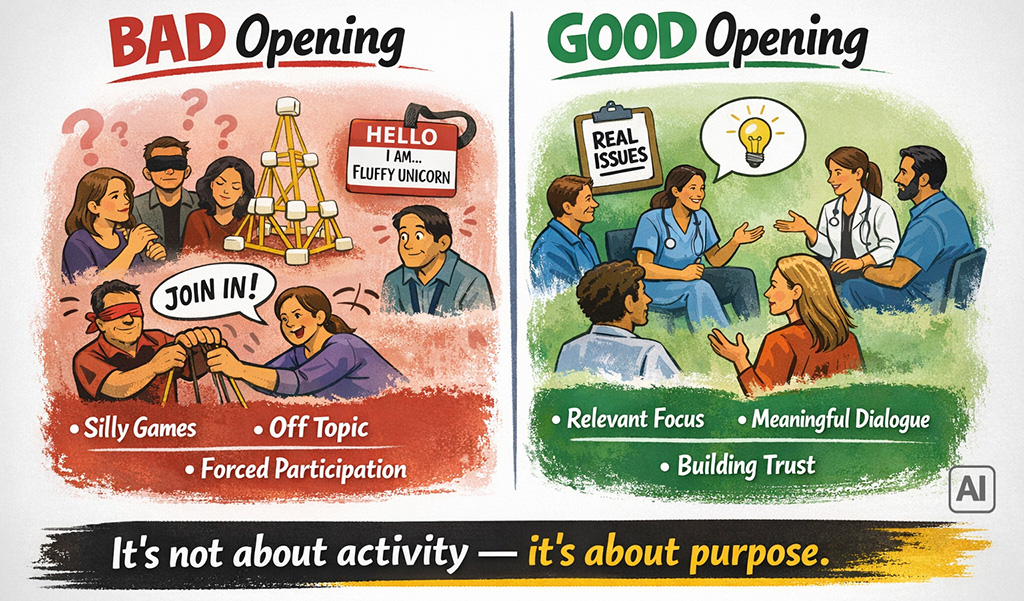
Completely disconnected from the topic. A group of experienced professionals doesn’t need to build a tower out of spaghetti to feel connected. They need something that respects why they are there.

Activities designed for teenagers, used on adults. This breaks trust very quickly. It feels patronising.

Participation that isn’t really optional. When saying “no” feels impossible, we are not creating safety. We are creating pressure.

The difference between a good opening and a bad one isn’t the activity — it’s whether anyone in the room actually needed it.

So When Do Icebreakers Actually Make Sense?

Icebreakers are like salt — a pinch at the right moment makes everything better, but if you keep adding it throughout the meal, people start quietly looking for the exit.
I haven’t given up on them completely.

Done well, with intention, they can be useful. But only in the right moment.

For me, that moment is the first meeting of a group — especially in a Flipped Learning 3.0 setting. When people come together after working with content on their own, they arrive with ideas, questions, and experiences. They are ready to work together.

In that situation, a well-designed opener can help build trust and create a shared starting point.

But only once. That’s it.

If you keep using icebreakers again and again, they lose their value. The group has already formed. Move on.

For an icebreaker to be worth the time, it should:

  • have a clear purpose
  • fit the group
  • connect to the topic
  • feel genuinely optional

A group of nurses discussing a real communication challenge from their work — that works. Asking them about their “spirit animal” does not.

What About Online?

Online sessions are different.

The small, informal moments that happen naturally in a room don’t exist. There is no chat before things start. No quick conversation in the break.

So yes, in online settings, it can make sense to create space for connection.

But it needs to be done carefully.

Technology already creates distance. Silence feels longer. Not everyone feels comfortable speaking or being on camera. If an activity doesn’t work, it is much harder to recover. Simple tools like short polls, word clouds, or one focused question can work well. But the same rule applies: it needs a purpose, and it needs to feel natural.

So: What Do We Do Instead?

If many traditional icebreakers don’t work, the question becomes simple: what should we do instead?

We don’t need to remove openings. We need to design them better.

A good opening is not an activity. It is a function.

Its job is to help people move into learning, quickly and respectfully.

That might mean asking a question that connects to their experience.
It might mean giving a short moment for reflection.
It might mean a quick exchange in pairs about a real situation from their work.

When it is done well, it doesn’t feel like an “icebreaker”.

It feels like the learning has already started.

What Theory Actually Tells Us

If we look at how adults learn, this all makes sense.

Adults do not come into a room empty. They bring experience, expectations, and a need for relevance. If we ignore that, we lose them early.

Learning also does not start after an activity. It starts immediately. From the first minute, people are already making sense of what is happening.

That means the opening matters. It is not a warm-up. It is part of the learning.

Many trainers use icebreakers to create connection or psychological safety. That intention is important. But safety does not come from forced playfulness. It comes from respect, clarity, and the feeling that participation is real and optional.

Motivation works in a similar way. People engage when they feel that what they are doing makes sense, that they are taken seriously, and that they have some control over their participation.

In Flipped Learning 3.0, this becomes even clearer. When learners arrive prepared, the group space is not there to “get started”. It is there to think, discuss, and work together. A poorly chosen icebreaker can interrupt that process.

These ideas are not new. Malcolm Knowles showed that adult learning depends on experience and relevance. Piaget and Bruner described learning as an active process of making meaning. Vygotsky highlighted the importance of meaningful interaction. Kolb connected learning to real experience and reflection. Deci and Ryan showed how motivation depends on autonomy, competence, and connection.

All of this points in the same direction.

Good openings do not “break the ice”.
They help people start learning.

Rethinking Icebreakers for the Future

Maybe the real question is not: What is a good icebreaker?

Maybe the real question is: What does this group need right now to start learning well?

The best icebreaker is sometimes no icebreaker at all — just a good question and the confidence to trust your group.
Sometimes, that might still look like an icebreaker. Especially in a new group, or online.

But often, it won’t.

Sometimes, the best start is a good question.
Sometimes, it is a brief moment to think.
Sometimes, it is simply starting clearly and getting into the topic.

As educators, we have a responsibility here.

We should be able to explain why we do what we do. Not with vague ideas about “energy”, but with a clear link to learning.

If an activity does not serve that, it does not belong.

Happy people during the starting activity
A good start doesn’t need a gimmick — just a clear purpose and a room full of people who feel it’s worth their time.

A Final Thought

In the end, this is not really about icebreakers.

It is about intention. It is about whether we design learning for the people in the room — or for our own habits. Participants notice. They know when something is meaningful, and when it is not.

If you are going to use an icebreaker, make it count.

If you can’t explain, in one sentence, why this activity helps this group learn at this moment — then maybe the best thing you can do is simply start.

A Note on Terminology

To avoid confusion, here is how I use these terms:

Icebreaker
An activity to help people get to know each other and feel more comfortable in a new group.

Opener
A starting activity that connects directly to the topic and helps begin the learning process.

Energiser
A short activity used during a session to bring energy back.

Check-in
A brief moment at the start where participants share how they are or what they expect.

Transition activity
A short activity that helps move from one part of a session to another.

This article was published as part of the BonJou! project, which included a series of training sessions for coaches, media educators, and interested adults.

Funded by the European Union. Views and opinions expressed are however those of the author(s) only and do not necessarily reflect those of the European Union or the European Education and Culture Executive Agency (EACEA). Neither the European Union nor EACEA can be held responsible for them.