
To ensure transparent, reliable and consistently high-quality learning provision, we have established a comprehensive quality assurance system for the development and award of Micro-Credentials.
Quality Assurance for Micro-Credentials
Quality is an important part of all our educational activities. For this reason, we have developed a Micro-Credentials Framework, based on a Quality Assurance Handbook for Micro-Credentials. It provides the framework for the development, delivery, assessment and continuous improvement of our courses and Micro-Credentials. The handbook is based on the European approach to Micro-Credentials for lifelong learning and employability and its quality principles.
Our Quality Assurance Handbook
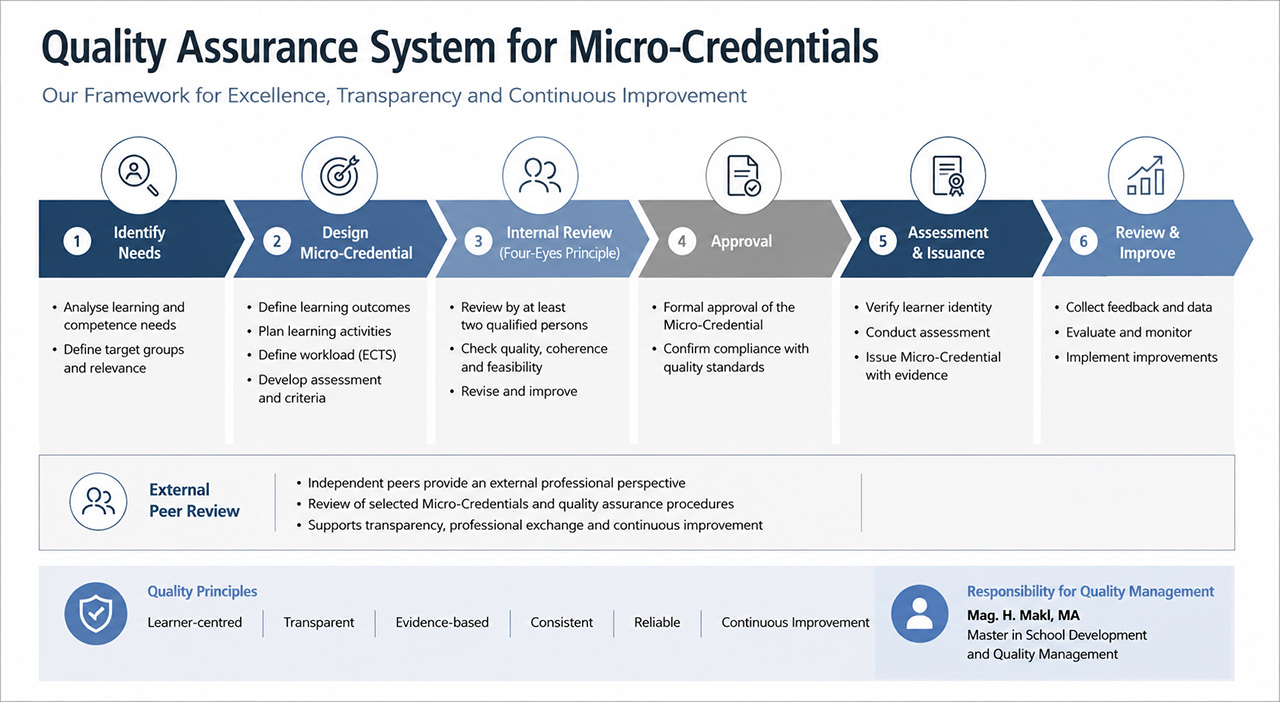
The Quality Assurance Handbook for Micro-Credentials defines clear procedures for developing and awarding Micro-Credentials. It covers the complete quality process, including:
- identification of learning needs and target groups,
- definition of clear and assessable learning outcomes,
- development of suitable learning activities,
- definition of the expected workload,
- development of appropriate assessments,
- transparent assessment criteria and pass requirements,
- internal quality review based on the four-eyes principle,
- formal approval,
- documentation and issuance of Micro-Credentials,
- learner feedback and evaluation,
- complaints and appeals,
- external peer review, and
- continuous improvement.
An important principle is that a Micro-Credential is not simply a certificate of participation. It confirms that defined learning outcomes have been achieved and demonstrated through an appropriate assessment.
Micro-Credentials for Our Courses
Based on this Quality Assurance Handbook, we will introduce Micro-Credentials for selected courses in the future. These Micro-Credentials will provide learners with transparent evidence of the knowledge, skills and competences they have acquired. Each Micro-Credential will be linked to clearly defined learning outcomes, workload and assessment requirements.
Micro-Credentials may be offered as individual learning units or as part of larger learning pathways. This makes it possible to combine smaller learning achievements and gradually build broader competences.
Internal and External Quality Assurance
Our quality assurance system combines internal review with external peer review. Before a new Micro-Credential can be issued, its design and assessment are reviewed according to the four-eyes principle. This helps to ensure that learning outcomes, learning activities, workload and assessment are coherent and appropriate. In addition, the handbook establishes an external Peer System. Independent peers provide an external professional perspective and review selected Micro-Credentials as well as the practical implementation of our quality assurance procedures.
The Peer System supports transparency, professional exchange and continuous improvement. Peer review is an instrument of external quality assurance; it does not constitute formal accreditation.
External Peerw
- E-Katarti-C
Responsible person: Michail Filioglou
Contact:
E-Katarti-C will contribute an independent external perspective to our quality assurance process and support the further development of our Micro-Credential system.
Responsibility for Quality Management
Responsibility for the organisation and coordination of our quality management lies with:
Mag. H. Makl, MA
Quality Management
H. Makl holds a Master’s degree in School Development and Quality Management and is responsible for coordinating the quality assurance system, including quality reviews, evaluation, continuous improvement and cooperation with external peers.
A Continuous Quality Process
Quality assurance does not end when a course or Micro-Credential has been developed. Learner feedback, assessment results, feedback from educators and stakeholders, complaints and appeals, and the results of external peer reviews are systematically considered.
Our approach follows a continuous quality cycle:
Plan → Implement → Assess → Review → Improve
Through this system, we aim to ensure that our future Micro-Credentials are transparent, reliable, assessable and relevant to learners and professional practice.
The Quality Assurance Handbook for Micro-Credentials provides the common framework for this work and will guide the development and award of our Micro-Credentials in the coming years.
References and used frameworks
-
Council Recommendation on Micro-Credentials (2022):
Council Recommendation of 16 June 2022 on a European approach to micro-credentials for lifelong learning and employability (2022/C 243/02). This is the core policy standard for developing, assessing, and assuring the quality of short learning experiences across Europe. -
European Digital Competence Framework (DigComp):
DigComp 3.0 defines the 5 core areas of digital skills needed by citizens and learners (Information literacy, Communication, Content creation, Safety, and Problem solving). Provides the learning outcomes baseline for micro-credentials that focus on digital skills. - European Framework for the Digital Competence of Educators
DigCompEdu – Sets out 22 specific competencies across 6 domains for educators (such as professional engagement, digital resources, teaching, and assessment). It serves as the quality reference when developing micro-credentials aimed at teacher training.